What a Transmission Actually Does
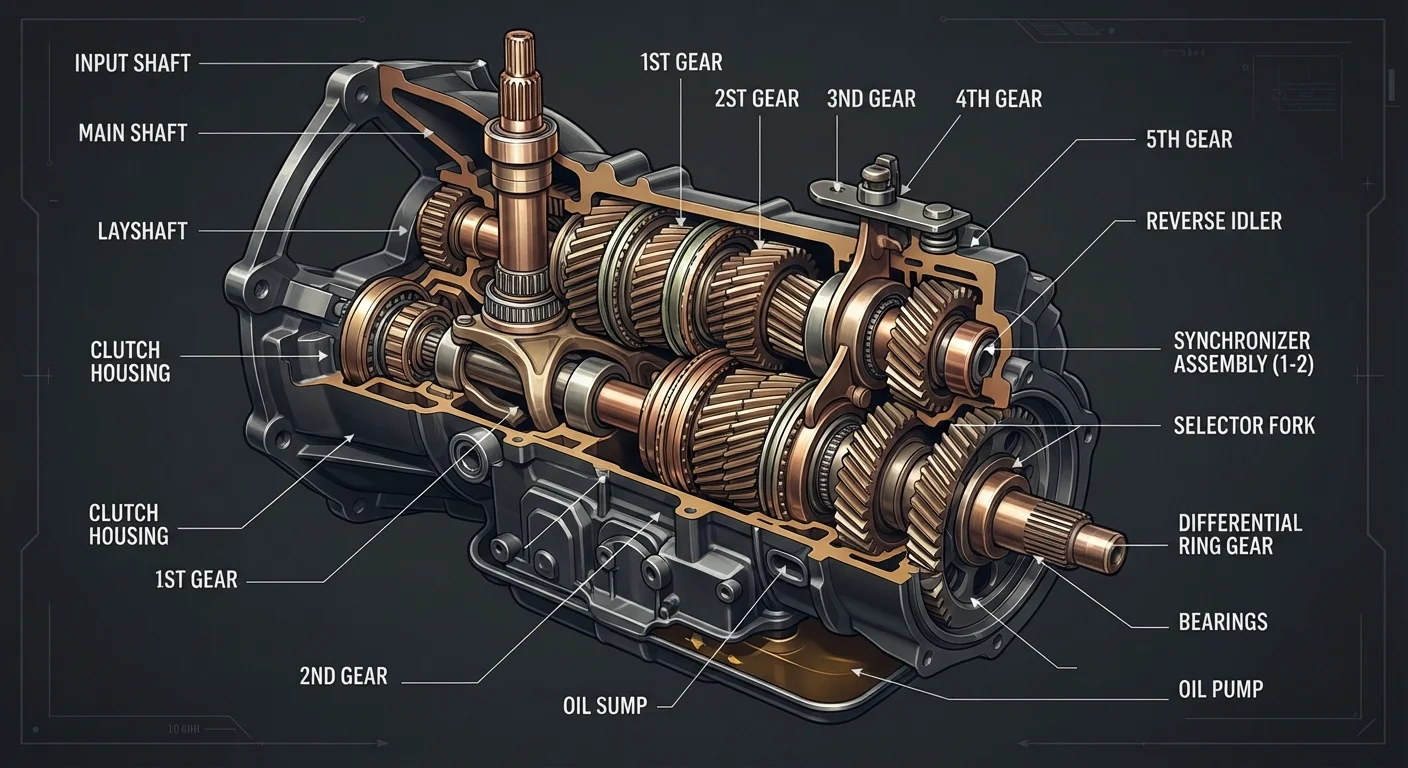
Your engine produces power within a fairly narrow range of rotational speeds. Too slow and it stalls; too fast and it damages itself. A transmission solves this problem by acting as an intermediary-converting engine output into the right amount of force and speed to move your car under any driving condition.
Think of it this way: starting from a dead stop requires a lot of torque but not much speed. Cruising at 65 mph requires sustained speed but less brute force. The transmission continuously adapts the relationship between engine speed and wheel speed to match what the situation demands. This is what gear ratios do in practice-lower gears multiply force for getting moving; higher gears optimize efficiency for cruising.
Understanding this basic function makes it easier to understand why how your engine works is directly connected to how your transmission behaves-the two systems are designed as partners.
~96%
New U.S. cars sold with automatic transmissions
Industry sales data consistently shows that automatic transmissions account for the large majority of new vehicle sales in the United States, with manual transmissions representing a small and declining share of the market.
30,000-60,000 mi
Typical automatic transmission fluid change interval
Many manufacturers recommend this range under normal driving conditions, though severe-duty driving (towing, stop-and-go traffic) may shorten it; always verify with your owner's manual.
Automatic, Manual, and CVT: Key Differences
Automatic transmissions use a hydraulic system, a component called a torque converter, and electronic sensors to select and change gears without driver input. Modern automatics commonly have six to ten forward gear ratios. They are the dominant transmission type in the U.S. market and are generally easier to operate in heavy traffic.
Manual transmissions require the driver to engage and disengage a friction clutch-using the left foot pedal-while physically moving the gear lever to select the appropriate gear. This puts direct control in the driver's hands and historically offered advantages in fuel efficiency and mechanical simplicity, though modern automatics have largely closed those gaps.
Continuously Variable Transmissions (CVTs) replace fixed gear steps with a belt running between two variable-diameter pulleys. The ratio changes fluidly and infinitely within a range rather than in discrete jumps. CVTs are common in smaller cars and hybrids, where their efficiency benefits are most pronounced. Some drivers find the sensation unfamiliar-engine RPM can rise and hold steady during acceleration rather than stepping up in distinct increments.
Match Your Driving Style to Your Transmission
If you drive a manual, avoid 'riding' the clutch-resting your foot on the pedal while moving-since this accelerates clutch wear. Automatic drivers should avoid excessive 'jack-rabbit' acceleration from stops, which puts added thermal stress on transmission fluid. Small habits make a meaningful difference in long-term transmission health.
Why It Matters for Maintenance
Your transmission type directly determines how you maintain it. Automatic and CVT transmissions rely on specific hydraulic fluids that degrade over time and must be replaced at manufacturer-specified intervals. Using the wrong fluid-or skipping changes-can cause expensive internal damage. Manual transmissions use a different type of gear oil and generally have simpler fluid service requirements, though they are not maintenance-free.
Beyond fluid, manual transmissions have a clutch assembly that wears with use and will eventually need replacement-a significant repair whose timing depends heavily on driving habits. Aggressive city driving typically wears a clutch faster than steady highway use.
The single most reliable source for your specific service intervals and fluid specifications is your owner's manual. As covered in reading your owner's manual, those pages contain vehicle-specific guidance that generic advice cannot replicate. You can also explore the full range of upkeep guidance at Car Maintenance.
Knowing your transmission type also helps you describe symptoms accurately to a mechanic-a skill that becomes more valuable when you're already familiar with the key parts of your car by name.
Dual-Clutch Transmissions: A Note
Some vehicles use a dual-clutch transmission (DCT), which uses two separate clutch packs for odd and even gears, enabling faster gear changes than a traditional automatic. DCTs behave like automatics from the driver's perspective but have distinct maintenance requirements-including specific fluids and service intervals. If you're unsure what type of transmission your vehicle has, your owner's manual or a dealership service department can confirm it.
How Transmission Type Connects to Drivetrain
Your transmission doesn't operate in isolation-it feeds power to the drivetrain, which then determines which wheels receive that power. Whether your vehicle is front-wheel drive, rear-wheel drive, or all-wheel drive, the transmission is the upstream component that the entire system depends on. A fault in the transmission affects everything downstream.
For a fuller picture of how power distribution works after it leaves the transmission, understanding AWD, 4WD, and FWD explains how each drivetrain configuration handles real-world road conditions. If you're newer to car ownership overall, a broader first-year ownership guide provides useful context across all the major systems you'll encounter.