Warning Signs Your Battery Is Losing Strength
A failing battery rarely quits without giving some advance notice. Recognizing the symptoms early can be the difference between a planned replacement and a parking-lot breakdown.
Slow or labored engine cranking is the most telling early warning. When you turn the key or press the start button, the starter motor draws a large burst of current from the battery. If the engine turns over sluggishly - especially on a mild-weather morning - the battery may no longer be delivering full power under load.
Dimming headlights and interior lights are another signal. Electrical systems depend on the battery to stabilize voltage when the engine is idling or off. Lights that appear noticeably dimmer than usual, or that brighten when you rev the engine, suggest the battery is struggling to maintain adequate voltage.
Electrical gremlins - erratic behavior from infotainment systems, power windows moving slowly, or warning lights flickering - can sometimes trace back to inconsistent battery output rather than a faulty component.
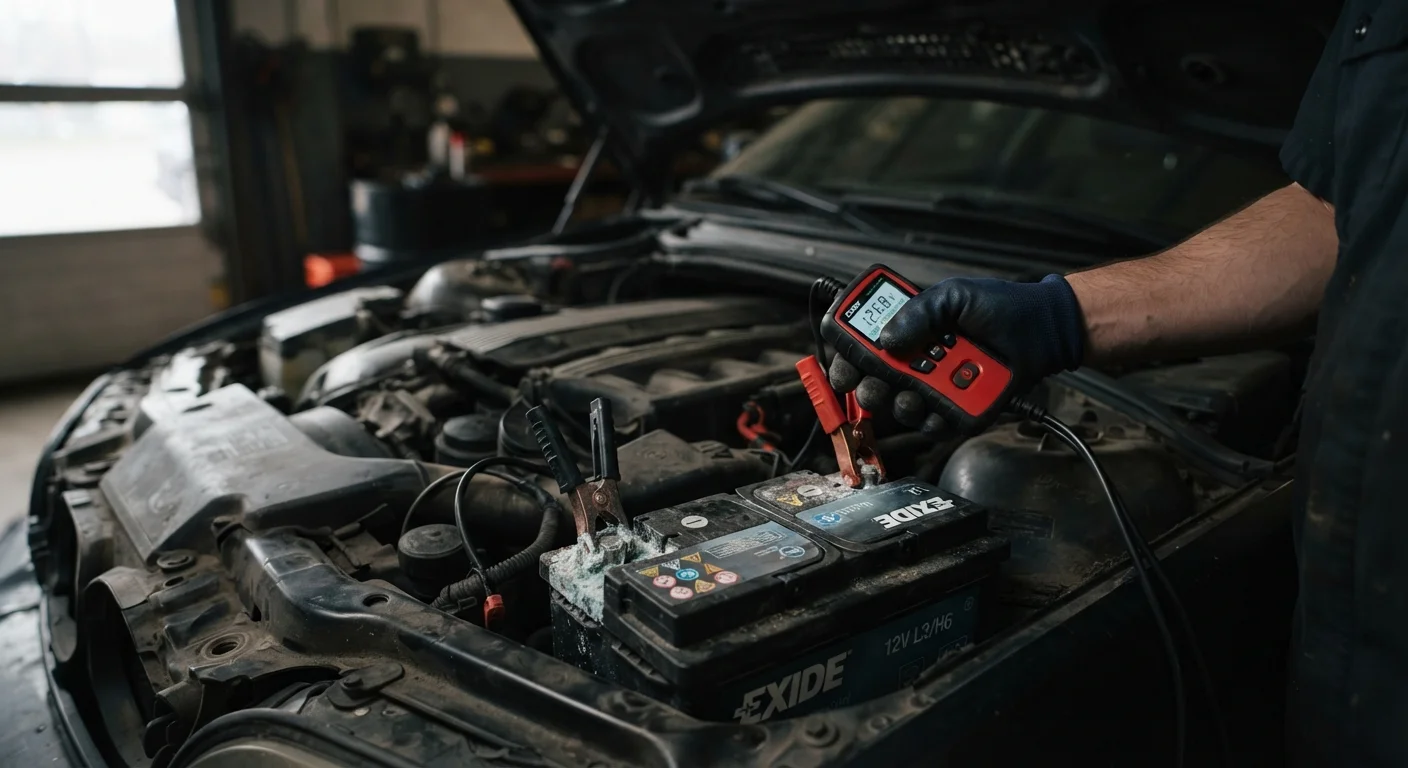
Visible corrosion on terminals (a white or blue-green powdery buildup around the positive and negative posts) can also reduce electrical flow and mimic the symptoms of a weak battery. Cleaning terminals and retesting is a logical first step before assuming the battery itself has failed.
A battery warning light on the dashboard typically indicates a problem with the charging system - which includes both the battery and the alternator. Either component can trigger it.
Test Your Battery Before Winter Arrives
Cold weather doesn't kill batteries - it exposes batteries that are already weakened. Having a load test done in early autumn gives you an accurate picture of remaining capacity while there's still time to replace the battery before freezing temperatures reduce its output. Most auto parts retailers offer free battery testing.
What Shortens a Car Battery's Lifespan
Understanding what degrades a battery helps you manage the factors you can control.
3-5 years
Typical lead-acid car battery lifespan
According to AAA, most conventional automotive batteries reach the end of their reliable service life between three and five years, with climate playing a significant role in where a battery falls within that range.
~30-60%
Cold cranking power lost at freezing temperatures
Battery Council International notes that a lead-acid battery can lose a substantial portion of its cranking power in freezing conditions, often exposing existing weakness in aging batteries.
50%
Batteries that fail without prior testing
AAA research has found that a significant share of roadside battery failures occur in batteries that were never professionally tested, underscoring the value of routine load testing after year three.
Heat is the primary enemy. High under-hood temperatures accelerate the internal chemical reactions inside a lead-acid battery, causing grid corrosion and water loss from the electrolyte. Drivers in consistently hot climates may see battery life closer to two to three years rather than four or five. This parallels how heat affects other battery-powered devices - as explored in guides on protecting electronics from temperature extremes.
Short-trip driving patterns are another significant factor. Each cold start draws a heavy current from the battery. The alternator then recharges it as the engine runs - but that process takes time. Trips under ten minutes may not fully restore the charge consumed at startup, leading to a gradual, cumulative discharge cycle that stresses the battery over time.
Deep discharges - draining the battery nearly or completely flat - cause lasting internal damage to lead-acid batteries. Leaving lights on overnight, or letting a car sit unused for weeks, can cause a partial or full discharge that permanently reduces capacity.
Overcharging from a faulty voltage regulator or aging alternator can also damage cells by producing excess heat and gassing inside the battery case.
Age alone plays a role. Even a well-maintained battery undergoes gradual sulfation - a buildup of lead sulfate crystals on internal plates - that slowly reduces its capacity to accept and hold a charge. This is part of the broader electrochemical wear that affects all battery chemistry, which applies to lithium-ion cells in consumer electronics as well.
How to Check Battery Health and When to Replace
Visual inspection is a starting point, not a conclusion. A battery can look clean and intact while operating well below rated capacity. A load test, performed by most auto parts retailers and repair shops, applies a controlled electrical load to the battery while measuring voltage - this reveals whether it can actually sustain output when it matters most. It's the most accurate field assessment available.
Many modern scan tools and battery analyzers can also report Cold Cranking Amps (CCA) - the battery's ability to deliver starting current at low temperatures - compared to its original rated specification. A significant drop from the rated CCA suggests replacement is approaching.
When to replace: A battery that tests below 70-75% of its rated capacity is generally considered a replacement candidate by industry convention, even if the car is still starting. Waiting until a battery completely fails increases the risk of being stranded and, in some vehicles, can require resetting electronic systems after replacement.
Keeping your charging system in good shape - including the alternator and serpentine belt - is equally important. A healthy battery connected to a failing charging system will still drain. Both components should be evaluated together.
For drivers aiming to maximize the overall health and longevity of their vehicle, battery care fits naturally into the broader discipline described in maintaining high-mileage vehicles: consistent attention to individual systems prevents compounding failures down the road.
AGM Batteries Have Different Characteristics
Many newer vehicles, particularly those with start-stop systems or significant electrical loads, use Absorbent Glass Mat (AGM) batteries rather than conventional flooded lead-acid batteries. AGM batteries are generally more resistant to vibration and deep discharge, but they also require an AGM-compatible charger and testing equipment. Using a standard charger on an AGM battery can damage it. Always confirm your vehicle's battery type before testing or charging at home.