Why These Terms Get Confused - and Why It Matters
Walk onto any car lot or scroll through any vehicle listing and you'll encounter AWD, 4WD, and FWD used almost interchangeably - sometimes even by salespeople. They are not the same system, and the differences have real consequences for how a vehicle handles in rain, snow, mud, and everyday highway driving.
Understanding your drivetrain - the components that deliver engine power to your wheels - helps you make sense of what your vehicle can realistically do and where its limits are. For a broader look at how power moves through a vehicle, see our explainer on how car transmissions work.
Front-Wheel Drive: The Everyday Standard
Front-wheel drive (FWD) routes engine power exclusively to the two front wheels. Those wheels handle both propulsion and steering simultaneously - a mechanical arrangement made possible by constant velocity (CV) joints, which allow the axles to flex through steering angles while still transmitting power. For a deeper look at components like CV joints, our guide to car parts you should know by name is worth reading.
FWD vehicles tend to be lighter, more fuel-efficient, and mechanically simpler than their AWD or 4WD counterparts. In light rain and packed-snow conditions, a FWD vehicle with quality tires performs well for the vast majority of drivers. The tradeoff: under hard acceleration or on steep, slippery grades, the front tires can lose grip more readily because they're managing two jobs at once.
Tires Matter More Than Drivetrain
A FWD vehicle on quality winter tires will outperform an AWD vehicle on worn all-season tires in snow and ice. Before assuming your drivetrain will carry you through winter, check that your tires are appropriate for the season and have adequate tread depth. Tread depth below 4/32 of an inch is generally considered marginal for wet or snowy roads.
All-Wheel Drive: Automatic Traction Management
All-wheel drive (AWD) systems power all four wheels, but unlike 4WD, they do so automatically and continuously. Sensors monitor wheel slip in real time, and a center differential or electronic coupling redistributes torque (rotational force) to whichever wheels have the most grip - often within milliseconds. The driver doesn't flip a switch or make any selection; the system manages itself.
This makes AWD particularly well-suited to variable road conditions: highways that shift from dry pavement to wet patches, or suburban roads after a moderate snowfall. It is not, however, designed for the kind of sustained, deep-mud or rock-crawling scenarios that 4WD handles. AWD also adds mechanical complexity and a modest fuel economy penalty compared to FWD.
| Front-Wheel Drive (FWD) | All-Wheel Drive (AWD) | Four-Wheel Drive (4WD) | |
|---|---|---|---|
| Wheels powered | Front two only | All four (automatic) | All four (driver-selectable) |
| Driver input required | None | None - fully automatic | Yes - must be engaged |
| Best conditions | Dry roads, light rain/snow | Mixed weather, wet/snowy pavement | Off-road, deep snow, mud, sand |
| Fuel economy impact | Most efficient | Modest penalty vs. FWD | Highest consumption |
| Mechanical complexity | Lowest | Moderate | Highest |
| Typical vehicles | Sedans, hatchbacks, minivans | Crossovers, SUVs, some sedans | Pickup trucks, off-road SUVs |
Four-Wheel Drive: Built for Serious Terrain
Four-wheel drive (4WD) - sometimes called 4x4 - is a driver-engaged system found primarily on trucks and body-on-frame SUVs. When activated (via a lever, dial, or button depending on the vehicle), it locks the front and rear axles to rotate at the same speed, delivering maximum traction across all four wheels simultaneously.
Most modern 4WD systems offer at least two modes: 4H (four-wheel high) for slippery roads at normal speeds, and 4L (four-wheel low) which multiplies torque for crawling through deep mud, sand, or rocky terrain at low speeds. Critically, 4WD engaged on dry pavement causes drivetrain binding - mechanical stress that can damage components - so it should only be used when traction is genuinely reduced.
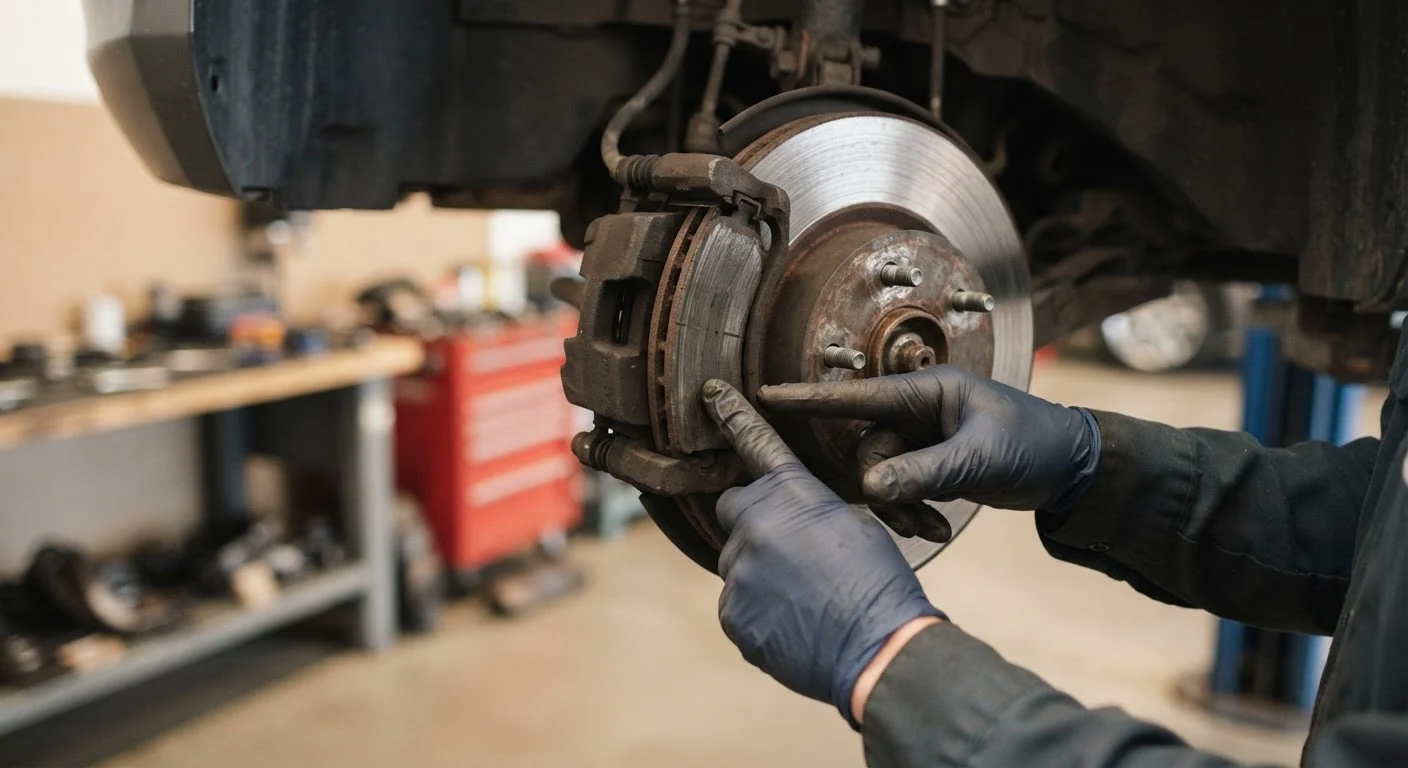
For a look at how your vehicle slows down once it's moving, our breakdown of disc brakes vs. drum brakes explains another critical system working alongside your drivetrain.
What No Drivetrain Can Do
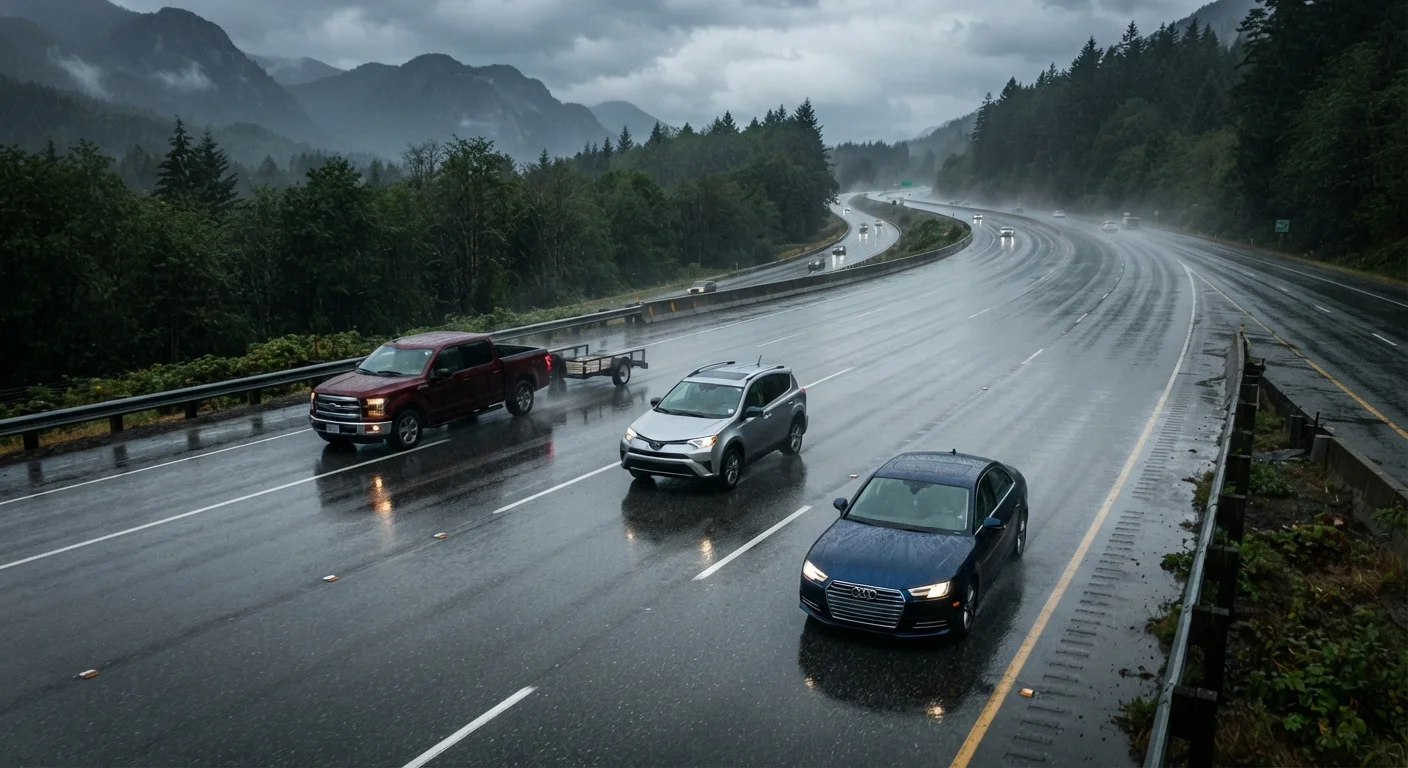
A common and dangerous misconception is that AWD or 4WD makes a vehicle more capable in all adverse conditions - including stopping. Drivetrain systems only affect how power is delivered to the wheels. They do not improve braking distance, steering response at the edge of grip, or handling when a vehicle is already sliding. Those outcomes depend on tire quality, road surface, and vehicle speed.
Drivers in snow or ice should reduce speed well below what their AWD system might make feel safe. Our guide to driving in bad weather covers the adjustments that matter most when conditions deteriorate - and many apply equally regardless of which drivetrain you're sitting behind.
AWD and 4WD Don't Shorten Stopping Distance
These systems improve your ability to accelerate and maintain forward motion in low-traction conditions - they have no effect on how quickly your vehicle stops. Following distances should be significantly increased in rain, snow, or ice regardless of your drivetrain. Overconfidence in an AWD or 4WD vehicle is a well-documented factor in winter-weather crashes.