The Physics Behind Stopping Your Car
When a hazard appears ahead of you, your car does not stop the instant you decide it should. Two separate phases unfold in sequence - and both consume distance at a rate most drivers dramatically underestimate.
The first phase is reaction distance: the space your vehicle covers while your brain processes the threat and your foot moves to the brake pedal. Human reaction time typically falls between 1.5 and 2.5 seconds under normal conditions. At 60 mph, that's 132 to 220 feet of road consumed before deceleration even begins.
The second phase is braking distance: the distance needed for your vehicle to decelerate from its current speed to zero. This figure is not linear - it scales with the square of your speed. A car traveling at 60 mph requires roughly four times the braking distance of a car traveling at 30 mph. That relationship catches most drivers off guard.
88 ft/sec
Distance traveled per second at 60 mph
At 60 mph, a vehicle covers approximately 88 feet every second - well before braking begins.
4×
Braking distance multiplier when speed doubles
Because braking distance scales with the square of speed, doubling your speed roughly quadruples the distance needed to stop.
~300 ft
Total stopping distance at 60 mph on dry pavement
Under typical conditions, a passenger car traveling at 60 mph needs roughly the length of a football field to stop completely.
Add those two phases together and you get your total stopping distance. On dry pavement at 60 mph with average reaction time, a typical passenger vehicle needs around 300 feet - roughly the length of a football field - to stop completely. That number climbs steeply in rain, on worn tires, or on a downhill grade.
Why Reaction Time Alone Won't Save You
Many drivers place too much confidence in their own reflexes. The assumption is simple: "If something happens, I'll react fast enough." But even a quick 1.5-second reaction time is meaningless if the gap ahead of you is only 50 feet - which, at highway speeds, disappears in well under a second.
This is the fundamental flaw in relying on reaction time rather than following distance. Reaction time is largely fixed - it's a biological constant influenced by alertness, age, and distraction. Following distance, by contrast, is entirely within your control at every moment. It's the variable you can actually adjust.
Make the 3-Second Check a Regular Habit
Every time you settle into a following position on the highway, run through the 3-second count. It takes about five seconds to check, and most drivers discover they're closer than they thought. Making this a routine check - especially after merging or recovering from a distraction - reinforces the habit before an emergency tests it.
Experienced drivers understand this trade-off intuitively. Rather than trusting their reflexes to bridge the gap, they build a buffer large enough that even an average reaction time leaves room to stop safely. This is a central principle of defensive driving: anticipating the scenario before it becomes a crisis.
Distraction makes this even more critical. A driver glancing at a navigation screen or adjusting the radio may add another full second to their reaction time - pushing total stopping distance well beyond 400 feet at highway speeds.
The 3-Second Rule and When to Extend It
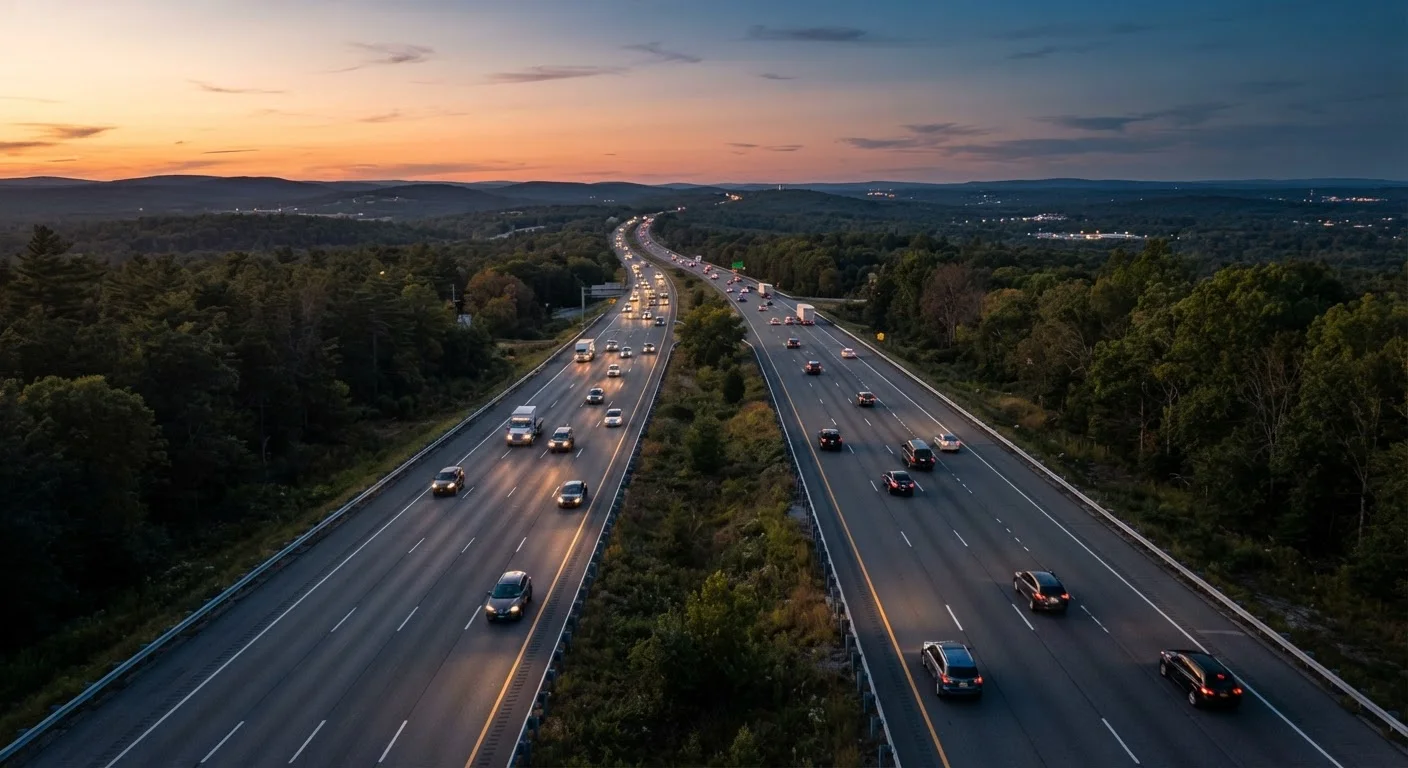
The 3-second rule is the most widely taught following-distance guideline in the United States. To apply it, identify a fixed point ahead - a sign post, a painted line, a bridge shadow. When the vehicle in front passes it, count three full seconds. If you reach that point before finishing the count, you're too close.
Under ideal conditions - dry road, daylight, alert driver, well-maintained vehicle - three seconds provides a workable minimum buffer. But ideal conditions are not the norm. Several factors call for extending that gap significantly:
- Rain or wet pavement: Extend to at least 4-5 seconds. Water dramatically reduces tire grip and lengthens braking distance.
- Night driving: Reduced visibility means hazards appear later in your field of view. See how darkness changes the driving equation for more on adjusting after dark.
- Towing or carrying heavy loads: Added weight increases the momentum your brakes must overcome, extending stopping distance.
- Following large trucks or SUVs: Their size blocks your forward sightline, reducing your ability to anticipate what they're reacting to.
- Tire wear or low tire pressure: Both reduce stopping grip. Tire pressure has a bigger effect on safety than most drivers realize.
The habit of consciously checking and adjusting your following distance - rather than setting it once and forgetting - is one of the defining habits of experienced drivers.
How Conditions and Environment Change the Math
Following distance is not a static number you set at the start of a journey. Road environment shifts the calculation continuously. In urban driving, speeds are lower but hazards are denser - pedestrians, cyclists, intersecting traffic, and sudden stops create unpredictable situations at close range. In rural settings, higher speeds and limited sight distances in curves mean the physical stopping requirement is larger even if traffic is lighter. Urban and rural roads present distinct risks even at identical speeds.
Snow and ice are in a category of their own. At 30 mph on packed snow, stopping distances can exceed those of a dry-road stop at 60 mph. Adjusting following distance to 8 or more seconds in these conditions is not excessive - it's proportionate to the physics at work.
Vehicle Condition Affects Stopping Distance Too
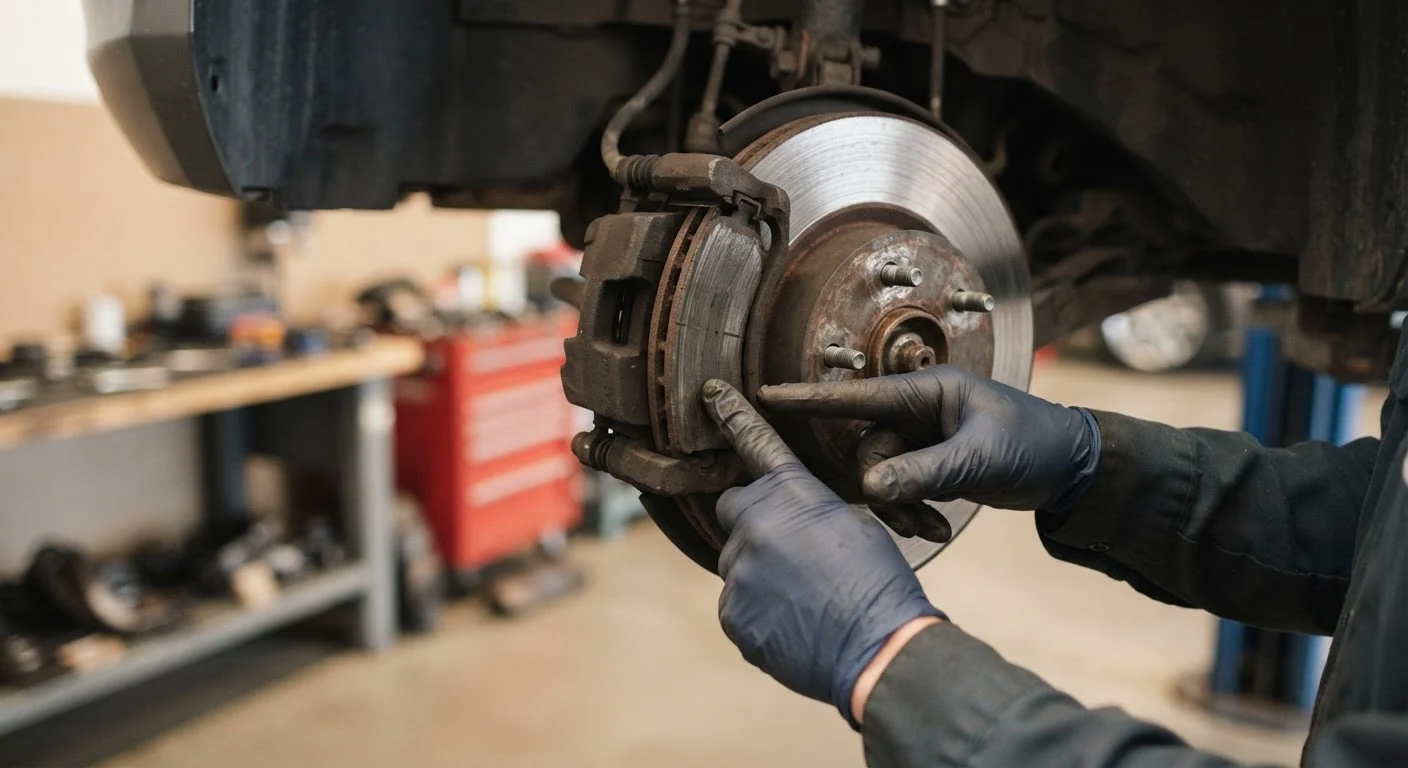
Following distance guidelines assume a vehicle with properly functioning brakes and adequately inflated tires in reasonable condition. Worn brake pads, low tire pressure, or tires past their tread life all increase stopping distance independent of the gap you maintain. Following distance and vehicle maintenance work together - neither substitutes for the other.
Ultimately, following distance is the one safety variable that costs you nothing to increase. It doesn't require faster reflexes, upgraded hardware, or special training - just the deliberate decision to leave more room and the discipline to hold that space even when other drivers fill it.