
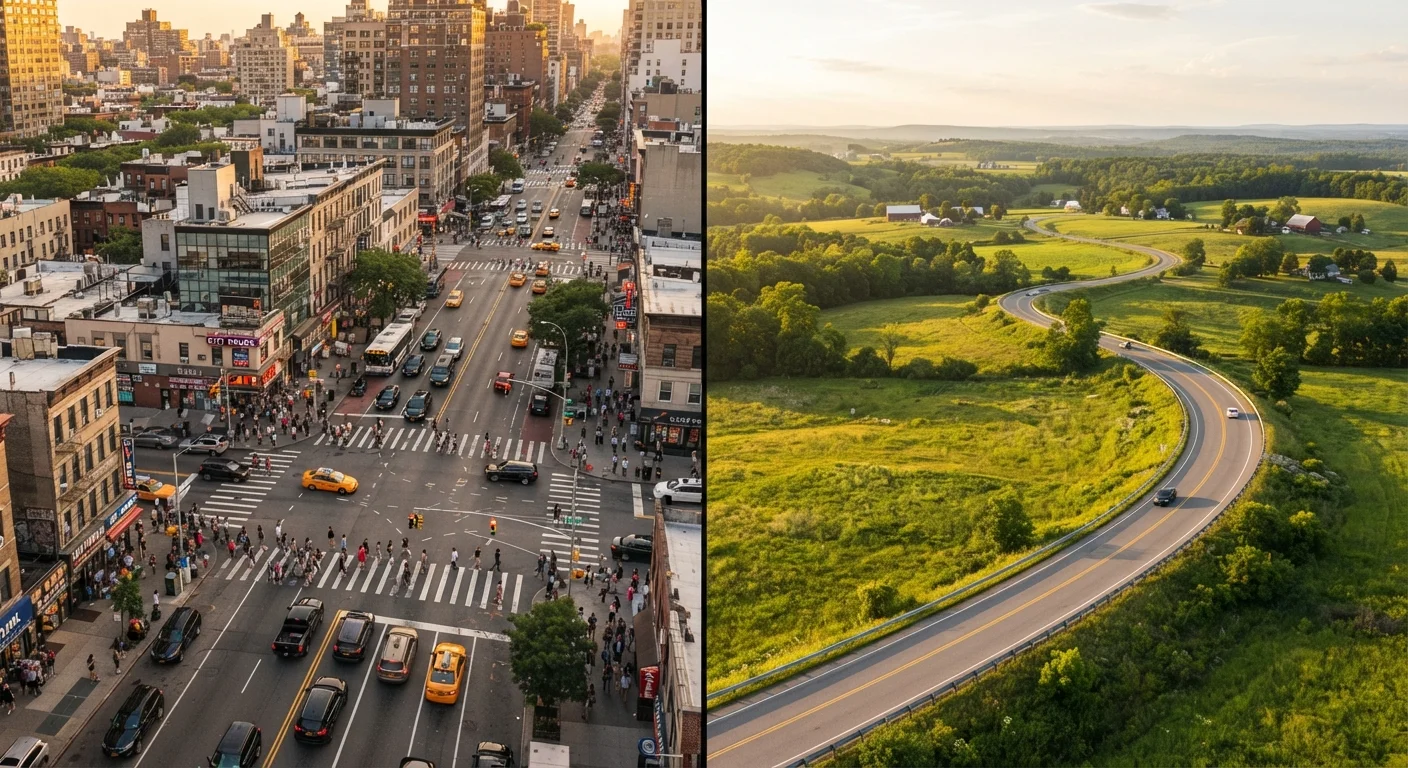
Why Environment Changes the Meaning of Speed
A posted speed limit of 45 mph feels routine on a straight suburban boulevard but can be genuinely hazardous on a tight rural curve bordered by deer habitat. Speed limits define the legal ceiling for a stretch of road under ideal conditions - they don't automatically define a safe operating speed for the specific moment you're driving it. Understanding why requires looking at how urban and rural roads differ at a structural level.
Urban environments compress hazards into tight spaces: pedestrians stepping off curbs, cyclists moving between lanes, delivery vehicles double-parked mid-block, and traffic signals that require quick, attentive decisions every few hundred feet. Rural environments spread hazards across long distances where the absence of visible danger encourages speed - right up until a blind curve, an unmarked intersection, or a deer crossing the road makes the margin for error vanishingly small.
According to the National Highway Traffic Safety Administration (NHTSA), rural roads consistently account for a disproportionate share of traffic fatalities relative to vehicle miles traveled, even though urban roads carry far more total traffic. That single data point captures the central paradox: the roads that feel safer often aren't.
~50%
Share of U.S. traffic deaths on rural roads
According to NHTSA data, rural roads account for roughly half of all U.S. traffic fatalities despite carrying a minority of total vehicle miles traveled.
7x
Greater fatality rate per mile on rural vs. urban roads
Research cited by the Insurance Institute for Highway Safety (IIHS) indicates rural roads carry a fatality rate per mile driven that is substantially higher than urban roads.
The Distinct Hazard Profile of Urban Driving
City driving is, in many ways, a continuous exercise in anticipation. The density of activity means threats can emerge from multiple directions simultaneously. Key hazards include:
- Pedestrian and cyclist conflicts: Urban cores have the highest concentration of vulnerable road users. A driver's scanning pattern must include crosswalks, bus stops, and the space between parked cars where pedestrians often appear with little warning.
- Intersection complexity: Multi-lane intersections with overlapping turning movements, obstructed sight lines, and frequent signal changes create conditions where right-of-way confusion leads to side-impact crashes.
- Stop-and-go traffic dynamics: Frequent deceleration means rear-end collisions are common. Maintaining a consistent following distance - even when traffic is slow - matters more than many drivers realize.
- Distraction density: Navigating unfamiliar streets, reading signs, and managing GPS directions all compete for attention. See our comparison of distracted and impaired driving risks for context on how cognitive load affects performance.
Urban driving also carries an emotional load. The frustration of congestion can escalate into aggressive behavior. Road rage and aggressive driving are measurably more common in high-density traffic conditions, which is a hazard in its own right.
Reset Your Mindset at Environment Transitions
One of the most overlooked moments in driving is the transition between environments - when a city street feeds onto a rural highway or vice versa. Your brain doesn't automatically update its risk model. Make a conscious mental note when your environment changes, and give yourself a few minutes to recalibrate your scanning habits, following distance, and speed before settling into a new routine.
The Distinct Hazard Profile of Rural Driving
Rural roads create a very different set of conditions. The open environment can lull drivers into a false sense of security - fewer cars on the road feels like less risk. But several structural features make rural roads genuinely dangerous:
- Higher operating speeds: With less traffic to regulate pace, drivers tend to travel faster. Higher speeds translate directly into longer stopping distances and more severe crash outcomes.
- Limited roadway infrastructure: Many rural roads lack guardrails, adequate shoulders, lane markings, or lighting. A single moment of overcorrection can send a vehicle off the road with nothing to arrest the slide.
- Narrow, undivided lanes: Two-lane rural roads put opposing traffic in close proximity. Head-on collisions, which tend to be among the most severe crash types, are far more common in rural settings.
- Wildlife and farm equipment: Animals crossing the road and slow-moving agricultural vehicles create sudden hazards that require immediate, controlled responses - the kind that high speeds make nearly impossible.
- Driver fatigue: Long, monotonous stretches actively induce drowsiness. Driver fatigue is particularly dangerous on rural highways where there are fewer environmental cues to sustain alertness.
Rural night driving compounds every one of these risks. Reduced visibility, limited lighting infrastructure, and the presence of wildlife make after-dark rural travel one of the higher-risk driving scenarios on public roads. Darkness changes the equation in ways that demand an entirely different level of caution.
Comparing the Two Environments Side by Side
Understanding how these environments stack up across key risk factors can help drivers calibrate their expectations before they turn onto an unfamiliar road.
| Risk Factor | Urban Roads | Rural Roads | |
|---|---|---|---|
| Primary hazard type | Pedestrians, cyclists, intersections | Speed, curves, wildlife, head-on crashes | |
| Fatal crash rate per mile traveled | Lower overall rate | Disproportionately higher rate | |
| Road infrastructure | Signals, markings, lighting common | Limited guardrails, lighting, shoulders | |
| Driver fatigue risk | Lower - environment stays stimulating | Higher - monotony induces drowsiness | |
| Typical crash type | Rear-end, sideswipe, pedestrian strikes | Head-on, run-off-road, animal strikes | |
| EMS response time | Faster - services nearby | Slower - remote locations delay help | |
| Aggressive driving risk | Higher - congestion triggers frustration | Lower - less traffic interaction |
Neither column is universally worse - they're simply different in kind. A skilled driver's advantage lies in recognizing which column applies to their current situation and adjusting accordingly. Experienced drivers build these context-switching habits deliberately over time, not by accident.
Adapting Your Driving to the Environment
The practical takeaway from this comparison is that safe driving isn't a fixed behavior - it's a set of adjustments applied to changing conditions. A few specific strategies apply to each environment:
In Urban Settings
- Reduce approach speed at intersections even when you have the right of way.
- Scan two to three intersections ahead, not just the one immediately in front of you.
- Increase following distance in stop-and-go traffic to give yourself reaction time.
- Expect the unexpected near parked cars, transit stops, and school zones.
In Rural Settings
- Treat the posted speed limit as a ceiling, not a target - especially on curves and at night.
- Use high beams on unlit roads when no oncoming traffic is present, and be ready to respond to wildlife.
- Take planned breaks on long drives to counter fatigue buildup before it affects judgment.
- Slow down significantly when approaching unmarked intersections or driveways where visibility is limited.
For a broader framework covering defensive techniques across all road types, Safe Driving From All Angles offers a comprehensive starting point.