Why Night Driving Is Genuinely More Dangerous
Roughly 40% of traffic fatalities in the United States occur at night, even though nighttime accounts for far less than half of all vehicle miles traveled, according to the National Safety Council. That disparity isn't coincidental - it reflects how fundamentally darkness changes the driving environment.
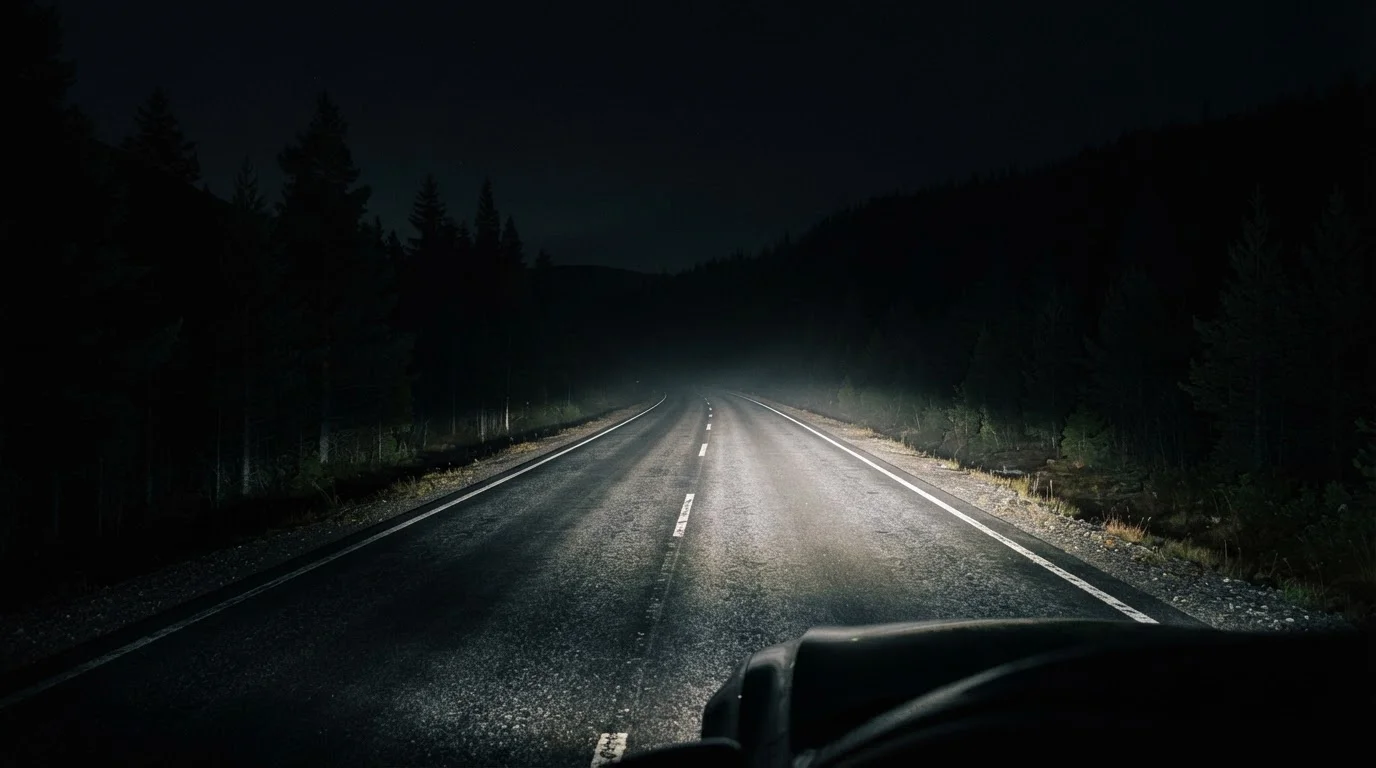
The human eye is not well-suited to low-light performance. At night, your visual acuity (sharpness of detail), color discrimination, and depth perception all decline. Peripheral vision narrows, making it harder to detect pedestrians, cyclists, or animals approaching from the sides. Even with headlights, a driver's effective sight distance is far shorter than the stopping distance needed at highway speeds - a mismatch that experienced drivers learn to consciously account for.
These conditions are compounded by driver fatigue, which naturally peaks during nighttime hours due to the body's circadian rhythm. Fatigue slows reaction time, distorts judgment, and in severe cases produces microsleeps - brief, involuntary lapses in consciousness that can last several seconds. At 60 mph, a two-second microsleep means traveling roughly 175 feet with no driver input at all.
~40%
Share of U.S. traffic fatalities occurring at night
The National Safety Council notes that nighttime fatalities are disproportionately high relative to the share of driving done after dark.
160 ft
Typical low-beam headlight range
At 60 mph, a vehicle requires more than 240 feet to stop - exceeding standard low-beam illumination distance, per automotive safety researchers.
Best Practices for Safer Night Driving
Adjusting your approach after dark isn't about being overly cautious - it's about matching your driving behavior to actual conditions. The practices below reflect what road safety research and experienced drivers consistently identify as effective.
Reduce your speed to match your actual sight distance, not the posted limit alone.
Headlights on low beam typically illuminate about 160 feet ahead, while high beams reach roughly 350-500 feet. At 60 mph, stopping distance can exceed 240 feet. Driving faster than your sight line allows is called 'overdriving your headlights' - and it's a significant factor in nighttime crashes.
Use high beams strategically and switch back promptly for oncoming traffic.
High beams nearly double your usable sight distance but are blinding to other drivers. Many drivers either never use high beams out of habit, or forget to switch back - both reduce safety. Proper use means activating high beams on dark, open roads and dimming them when another vehicle is within approximately 500 feet.
Increase your following distance to at least four seconds behind the vehicle ahead.
The standard three-second following distance assumes daylight and alert conditions. At night, reaction time tends to be slightly slower, visibility of brake lights and road hazards is reduced, and any mistake has less margin for correction. Our article on following distance explains exactly why this buffer matters.
Scan actively and broadly rather than fixating on the road directly ahead.
At night, peripheral vision weakens but remains your best tool for detecting movement - a pedestrian stepping off a curb, a deer at the shoulder, a cyclist without lights. Active scanning means regularly shifting your eyes to the road edges, mirrors, and intersection approaches rather than tunneling straight ahead.
Ensure your headlights, taillights, and windshield are clean and properly aimed before nighttime trips.
Dirty or misaimed headlights can reduce effective illumination by more than 50%, according to automotive lighting researchers. Taillights obscured by grime make your vehicle harder for following drivers to track. These are simple checks with meaningful safety returns.
Quick Actions You Can Take Tonight
Some nighttime safety improvements require no special equipment or training - just a deliberate change in habit. Start here:
For a broader look at the habits that distinguish careful drivers in all conditions, see our article on safe driving habits experienced drivers build over time. Night driving shares much of its risk profile with adverse weather - our guide to driving in rain, snow, fog, and ice covers the same principle of adapting speed and following distance to reduced visibility.
Rural Roads Carry Specific Night Risks
Unlit rural roads combine limited visibility with higher likelihoods of animal crossings, cyclists without lights, and slower-moving farm equipment. Reduce speed further on unfamiliar rural routes at night, and keep high beams active whenever traffic allows. Our article on urban vs. rural driving risks covers how to adapt your approach to each environment.
Managing Glare and Eye Fatigue
Oncoming headlights - especially modern LED and HID (high-intensity discharge) units - can temporarily blind a driver for several seconds. The correct response is to avoid looking directly at the oncoming light source. Instead, shift your gaze to the right edge of your lane and use road markings as a guide until the vehicle passes.
Keeping your windshield clean, inside and out, significantly reduces glare scatter. A film of interior haze from outgassing plastics or smoke can turn every oncoming light into a bloom. Dirty headlight lenses compound the problem from your end, reducing output and spreading light poorly - lenses that have yellowed or fogged can often be restored by a professional.
Vision Changes With Age and Night Driving
The ability to see clearly in low light declines noticeably with age. Older drivers may find that their night vision, glare recovery time, and contrast sensitivity are meaningfully reduced compared to younger years. If you notice difficulty reading signs or recovering from headlight glare, an eye exam with a qualified professional is a practical next step - it's a normal part of managing driving fitness over time.
Eye fatigue from sustained nighttime driving is real. Taking breaks every 90 to 120 minutes on long trips, keeping the interior light level low, and staying hydrated all help maintain alertness. If you find yourself repeatedly blinking hard, yawning, or struggling to hold your lane, treat these as genuine warning signs. As covered in our guide on driver fatigue, pulling over and resting is not a weakness - it's the right call.