Why Tire Pressure Is a Safety Issue, Not Just a Maintenance Detail
Most drivers think of tire pressure as a minor housekeeping task - something to address when the dashboard warning light appears. In reality, tire pressure sits at the center of how your vehicle handles, stops, and responds in an emergency. The four small patches of rubber contacting the road at any given moment are only as effective as the air pressure supporting them.
When pressure is correct, the tire's contact patch is the right size and shape. The tread makes even, full contact with the pavement, and the sidewall flexes as designed. When pressure is off in either direction, that contact patch distorts - and so does the tire's ability to do its job. Braking distances increase, cornering becomes less predictable, and the risk of a sudden failure rises.
For a broader look at the quick checks that keep you safe before you ever leave the driveway, see The Pre-Drive Safety Check Every Driver Should Know.
~1 PSI
Pressure lost per 10°F temperature drop
This relationship between temperature and tire pressure is a widely cited rule of thumb in automotive engineering and is referenced by the U.S. Department of Transportation.
25%
Pressure drop that triggers most TPMS alerts
Federal regulations require TPMS systems on passenger vehicles sold in the U.S. to alert the driver when pressure falls 25% below the vehicle's recommended level.
Up to 0.5%
Fuel economy gain per PSI increase toward target
The U.S. Department of Energy estimates that keeping tires properly inflated can improve gas mileage by up to 0.5% per PSI gained when tires are underinflated.
Underinflation vs. Overinflation: Different Problems, Both Dangerous
Underinflation is far more common and generally more dangerous. When a tire doesn't have enough air, its sidewalls flex excessively with every rotation. That repeated flexing generates heat, and heat is a tire's enemy. Over time - or quickly at highway speeds - the internal structure weakens, increasing the risk of a blowout. Underinflated tires also wear faster on the outer edges of the tread, reducing the tire's useful life.
Overinflation has its own set of consequences. A tire with too much air becomes rigid and rounds out, so only the center strip of the tread contacts the road. This reduces grip, makes the ride harsher, and causes accelerated wear down the center of the tread. An overinflated tire is also more vulnerable to damage from potholes and road debris because the sidewall has less ability to absorb impact.
Both conditions contribute to uneven tread wear that can make tire rotations more urgent and replacement more frequent.
Keep a Gauge in Your Glove Box
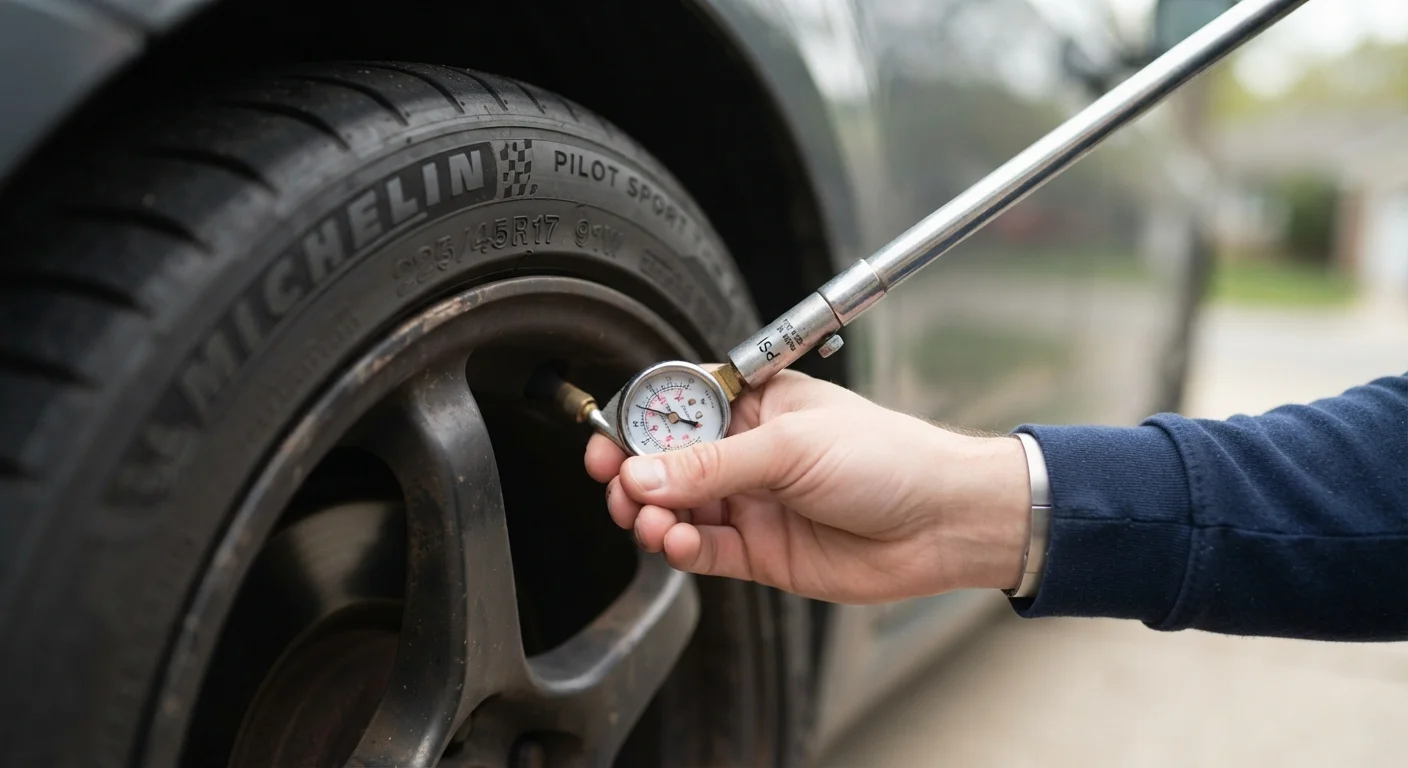
A basic digital or stick-type tire pressure gauge is inexpensive and accurate enough for regular home checks. Gas station gauges can be unreliable due to heavy use and weather exposure. Having your own means you can check cold pressure any time - before you've driven anywhere - which gives you the most accurate reading.
How to Check Tire Pressure Correctly
The single most important rule: check pressure when tires are cold. Driving heats the air inside the tire and temporarily raises the reading. "Cold" means the vehicle has been sitting for at least three hours or has been driven less than a mile at low speed. If you need to drive to a gas station to add air, check your pressure at home first with your own gauge so you know your starting point.
- Locate the recommended PSI - find the sticker on the inside edge of the driver's door jamb. This is your target, not the number on the tire sidewall. Your owner's manual lists it as well.
- Remove the valve cap from the tire's valve stem - the small rubber or metal nozzle on the inner rim.
- Press your gauge firmly onto the valve stem. A digital gauge gives a direct readout; a stick gauge shows a bar that slides out.
- Compare and adjust - add air if the reading is below the target, release air (using the small pin inside the valve) if it's above.
- Replace the valve cap to keep dirt and moisture out of the valve.
Repeat for all four tires, and don't forget the spare if your vehicle carries a full-size one.
Temperature, Seasons, and Pressure Changes
Air contracts when it cools and expands when it warms, which means tire pressure naturally fluctuates with the seasons. As a practical rule, expect to lose roughly 1 PSI for every 10°F drop in ambient temperature. A tire correctly inflated at 35 PSI during a summer afternoon may read closer to 31-32 PSI on a cold winter morning - low enough to affect handling and trigger the TPMS (Tire Pressure Monitoring System) warning light on many vehicles.
This is why monthly checks are far more useful than reacting only to dashboard warnings. The TPMS alert in most vehicles activates when pressure drops 25% below the recommended level - by that point, the tire has been underperforming for some time. Make pressure checks a habit at every season change and before any extended highway trip.
Tire pressure also interacts with other aspects of tire health. Alignment problems can compound uneven wear that improper pressure has already started, and consistent underinflation accelerates the kind of tread deterioration discussed in Why Skipping Tire Rotations Costs You More Than You Think.
TPMS Is a Warning System, Not a Maintenance Tool
The Tire Pressure Monitoring System built into most vehicles sold after 2007 is a safety alert, not a substitute for regular pressure checks. It only activates when pressure has already dropped significantly below the safe threshold. Relying solely on the warning light means your tires may have been operating underinflated for miles before you're alerted.