
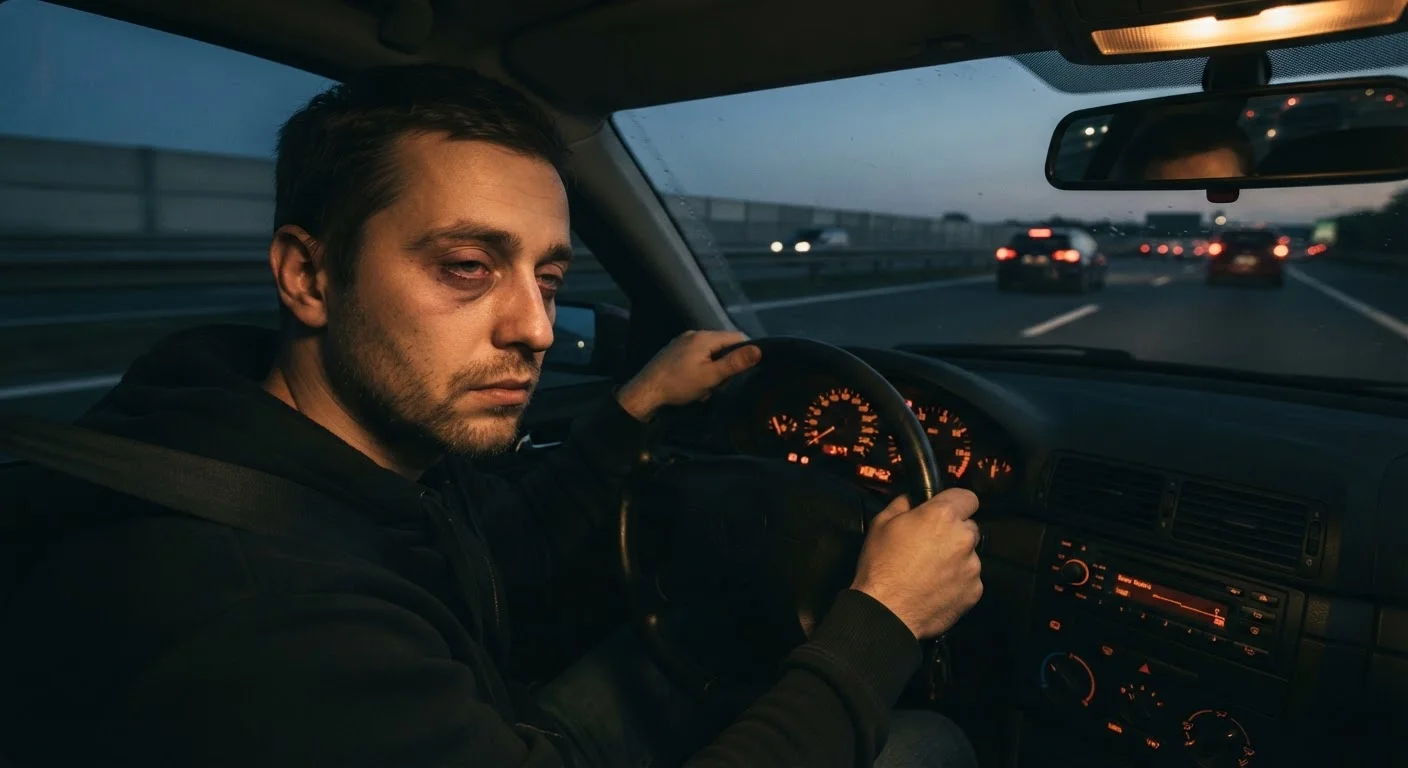
What Fatigue Actually Does to a Driver
Fatigue doesn't just make you feel sleepy - it systematically degrades the cognitive functions that safe driving depends on. Reaction time slows, attention narrows, and the ability to process multiple pieces of information simultaneously deteriorates. Drivers may drift between lanes, miss traffic signals, or fail to anticipate hazards that a rested driver would catch easily.
Research from the National Highway Traffic Safety Administration (NHTSA) has consistently linked drowsy driving to tens of thousands of crashes annually in the United States. One widely cited finding holds that being awake for 18 consecutive hours produces driving impairment roughly equivalent to a blood alcohol concentration (BAC) of 0.05% - and 24 hours without sleep pushes that equivalence closer to 0.10%, above the legal limit in every U.S. state.
One of the most dangerous aspects of severe fatigue is microsleep - brief, involuntary sleep episodes lasting just a few seconds. At highway speeds, a four-second microsleep means a vehicle travels the length of a football field without any driver input. Critically, drivers often have no memory of these episodes.
Fatigue Is Not the Same as Distraction
While both reduce driving performance, fatigue and distraction impair drivers through different mechanisms. Distraction diverts attention away from the road; fatigue degrades the brain's ability to process information at all, even when a driver is trying to focus. Understanding this distinction matters when assessing your own risk on any given trip.
For a broader look at how impairment affects driving performance, see our article on distracted vs. impaired driving.
When and Why Fatigue Risk Spikes
The human body follows a natural circadian rhythm that creates predictable windows of peak sleepiness. These windows fall primarily between midnight and 6 a.m. and again during the mid-afternoon (roughly 2-4 p.m.). Driving during these periods, even after a reasonably good night's sleep, carries elevated risk.
Long-haul and commercial driving are well-known high-risk contexts, but commuter and recreational drivers are just as vulnerable. A driver who had poor sleep the previous night, works a night shift, or is crossing multiple time zones faces compounding factors. Monotonous road environments - long stretches of interstate, flat rural highways - accelerate the onset of fatigue by reducing the stimulation that helps maintain alertness.
~0.05% BAC
Impairment equivalent after 18 hours awake
Research cited by the NHTSA equates 18 hours without sleep to a blood alcohol concentration of approximately 0.05%, impairing reaction time and judgment.
4-5 seconds
Duration of a typical microsleep episode
At 60 mph, a 5-second microsleep means a vehicle travels roughly 440 feet - the length of a football field - with no driver control.
~100,000
Police-reported drowsy-driving crashes annually (U.S.)
The NHTSA estimates approximately 100,000 police-reported crashes each year involve drowsy driving, though the true figure is believed to be higher due to underreporting.
Nighttime driving introduces additional hazards that overlap with fatigue. Our piece on night driving and reduced visibility explores how darkness amplifies risk when a driver's faculties are already compromised.
The Problem With Self-Assessment
One of the most insidious aspects of fatigue is that it impairs the very faculties needed to accurately gauge how impaired you are. Studies have shown that moderately sleep-deprived individuals consistently overestimate their own alertness and performance level. This creates a dangerous gap between perceived safety and actual ability.
Fatigue warning signs are recognizable before crisis
Symptoms like lane drifting, repeated yawning, and missing exits typically appear before a driver loses consciousness, providing a window to act.
Short naps can meaningfully restore alertness
A 20-minute rest stop has demonstrated measurable improvement in driving performance in controlled studies, making it a practical roadside option.
Risk windows are predictable by time of day
Because fatigue peaks align with circadian rhythms, drivers can plan trips to avoid the highest-risk windows of midnight-6 a.m. and mid-afternoon.
Awareness-building reduces underestimation
Drivers who understand how fatigue distorts self-perception are better positioned to act on objective warning signs rather than relying on how they feel.
Common warning signs worth taking seriously include: difficulty keeping eyes open, repeated yawning, drifting out of lane, missing exits or turns, and having no memory of the last few miles driven. If you recognize these in yourself, the correct response is to exit the road and rest - not to push through.
Impaired self-awareness masks the true risk
Sleep-deprived drivers routinely overestimate their own alertness, making them less likely to pull over even when objectively unsafe to continue.
Microsleeps occur without any warning or memory
These involuntary 4-5 second sleep episodes can happen mid-highway with no sensation of having lost consciousness, leaving the driver unaware of the lapse.
Common countermeasures are largely ineffective
Opening windows, loud music, and similar tactics have little evidence of sustained benefit and may give drivers false confidence to continue driving.
Cumulative sleep debt compounds crash risk
Even partial sleep deficits across multiple nights accumulate into significant impairment, meaning a driver who averaged six hours a night for a week is not well-rested.
Fatigue interacts dangerously with other risk factors
Combined with nighttime darkness, unfamiliar roads, or long monotonous stretches, fatigue multiplies crash risk beyond what any single factor alone would suggest.
See our guide on safe driving habits that experienced drivers build for context on how self-awareness fits into a broader defensive driving mindset.
Strategies That Help - and Their Limits
Short-term countermeasures can provide modest, temporary relief, but none of them replace actual sleep. Consuming caffeine, for instance, can improve alertness for 30-45 minutes, but the effect is delayed and temporary. Taking a brief nap of 20 minutes before driving - sometimes called a nap-plus-caffeine strategy - has shown more consistent benefit in research settings than either intervention alone.
Opening windows, turning up the radio, or splashing cold water on your face have minimal evidence behind them and should not be treated as reliable safety measures during serious fatigue. The only dependable solution is to pull over in a safe location and sleep.
Planning ahead remains the most effective tool: scheduling adequate sleep before long drives, identifying rest stops along your route, and being willing to share driving duties when possible are all practical steps. On road trips especially, drivers often underestimate how cumulative fatigue builds over several hours - the distinct risks of rural highway driving, including long monotonous stretches, can accelerate fatigue onset.
This article is for informational purposes only. It does not constitute medical or legal advice. Consult a qualified healthcare professional if you have concerns about a sleep disorder or medical condition affecting your driving ability.