Three Services, Three Different Jobs
When a shop recommends alignment, balancing, and rotation in the same visit, it can sound like they're describing variations of the same thing. They're not. Each service targets a distinct problem, uses different equipment, and produces different results. Understanding what each one actually does helps you have a more informed conversation with your mechanic - and helps you decide what's genuinely needed versus what can wait.
If you want a broader view of how these services fit into your overall upkeep schedule, your car's maintenance schedule decoded is a useful starting point.
Wheel Alignment: Angles, Not Tires
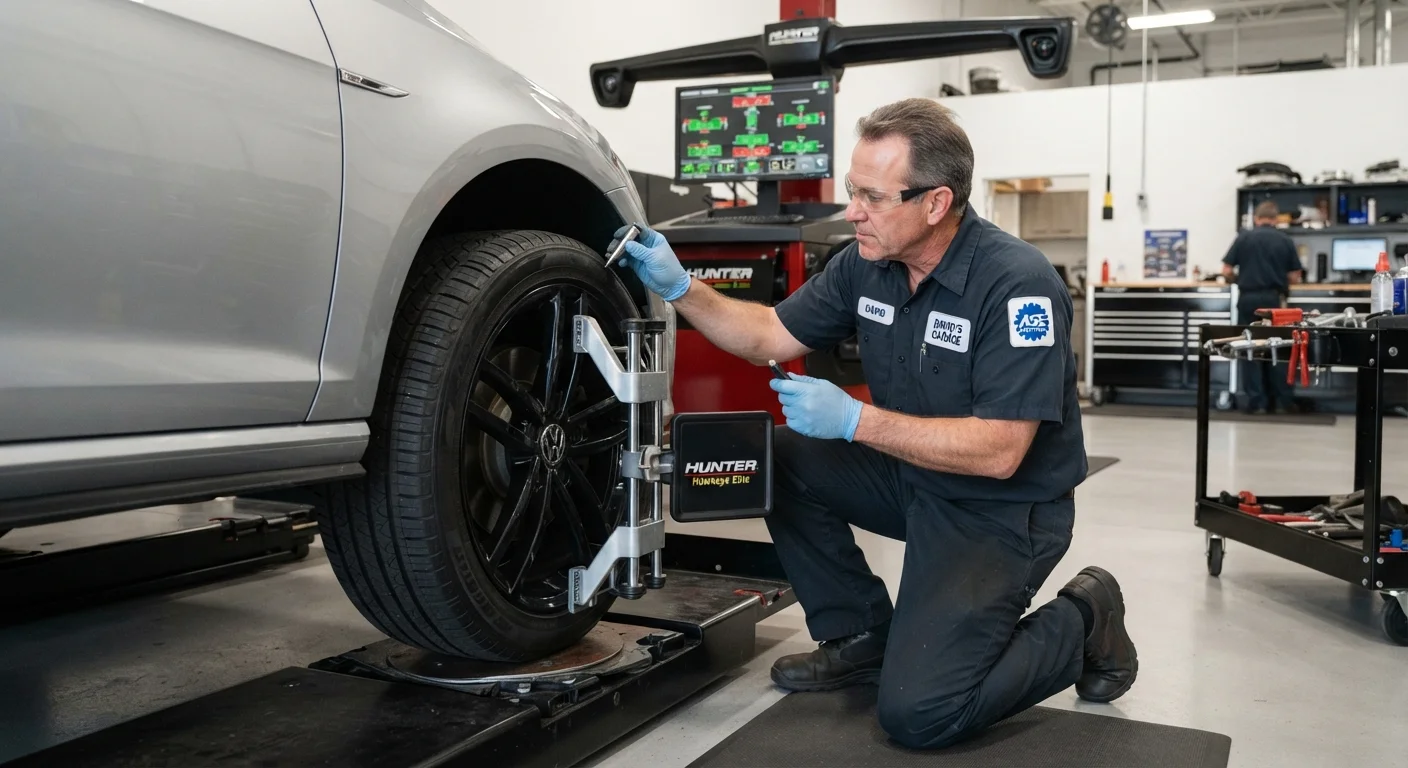
Alignment has nothing to do with moving tires around or adding weights. It's about adjusting the angles at which your tires meet the road. Technicians measure three key angles: camber (the inward or outward tilt of the tire when viewed from the front), toe (whether tires point slightly inward or outward when viewed from above), and caster (the angle of the steering axis, which affects stability).
When these angles drift out of specification - usually due to hitting a pothole, curb, or other impact, or simply through normal wear on suspension components - tires don't roll in the direction the car is pointed. The result is pulling to one side, a crooked steering wheel, or tires that wear unevenly across their width rather than uniformly. A proper alignment uses a machine to measure all four wheels and brings those angles back to the manufacturer's specifications.
Alignment Doesn't Fix Worn Suspension Parts
If the ball joints, tie rod ends, or control arm bushings are worn, an alignment adjustment won't hold - the looseness in those components will allow angles to shift again. A thorough shop will inspect suspension condition before performing an alignment. Ask whether any worn parts were identified during the inspection.
For a detailed look at the symptoms and causes of alignment problems, see our guide on understanding wheel alignment.
Tire Balancing: Smoothing Out the Spin
A tire and wheel assembly is never perfectly uniform in weight. Small variations in the rubber, the wheel casting, or even the valve stem can create tiny imbalances. At highway speeds, those imbalances cause the wheel to wobble slightly with each rotation - and that wobble is felt as vibration through the steering wheel, floorboard, or seat.
Balancing is done on a spin-balancing machine that identifies where the weight is uneven. A technician then attaches small adhesive or clip-on counterweights at precise points on the wheel rim to compensate. This is typically needed when new tires are mounted, when vibration appears, or after a significant road impact. It's a quick fix when done promptly, but ignored over time, imbalance accelerates wear on tires and suspension components.
Check Balance After Any Hard Impact
Hitting a significant pothole or curb can throw a wheel out of balance - or knock your alignment out of spec - even if nothing looks visibly damaged. If you notice new vibration or pulling after a hard road impact, have both balance and alignment checked. Catching the issue early prevents accelerated tire and suspension wear.
Tire Rotation: Spreading the Wear
Rotation doesn't adjust angles or add weights - it physically moves tires from one position on the vehicle to another. Front tires carry the engine's weight and, on front-wheel-drive vehicles, also handle acceleration and steering forces. That combination causes them to wear faster than the rears. Rotation systematically moves tires through different positions so no single tire bears a disproportionate workload.
The specific rotation pattern depends on your drivetrain (front-, rear-, or all-wheel drive) and whether your tires are directional (designed to spin only one way) or non-directional. A qualified shop will use the appropriate pattern for your vehicle. Skipping rotations costs more than you might expect - uneven wear forces premature replacement of the whole set, not just the worn tires.
5,000-7,500 mi
Typical tire rotation interval
Most vehicle manufacturers recommend rotating tires within this mileage range; consult your owner's manual for your specific model.
~$75-$100
Typical alignment check cost
Alignment service pricing varies by region and vehicle type; costs are general estimates and may differ at your local shop.
When You Actually Need Each Service
Knowing what each service does makes it easier to recognize when you need it. A vibration that appears at 65 mph and fades at 75 mph points toward balance, not alignment. A car that drifts left even on a flat, straight road suggests an alignment issue. Tires that look fine but are noticeably more worn on the inside or outside edge are a classic alignment symptom.
Rotation follows mileage intervals and benefits nearly every vehicle on a predictable schedule. Alignment and balancing are more event-driven - triggered by impacts, new tire installations, or noticeable handling changes. If you're working with a limited maintenance budget, prioritizing what actually matters can help you sequence services wisely.
Learning the names and functions of the parts involved - like suspension components, wheel hubs, and steering linkages - also helps. Knowing your car's key parts by name makes it significantly easier to understand what a mechanic is describing and why a service is recommended.