
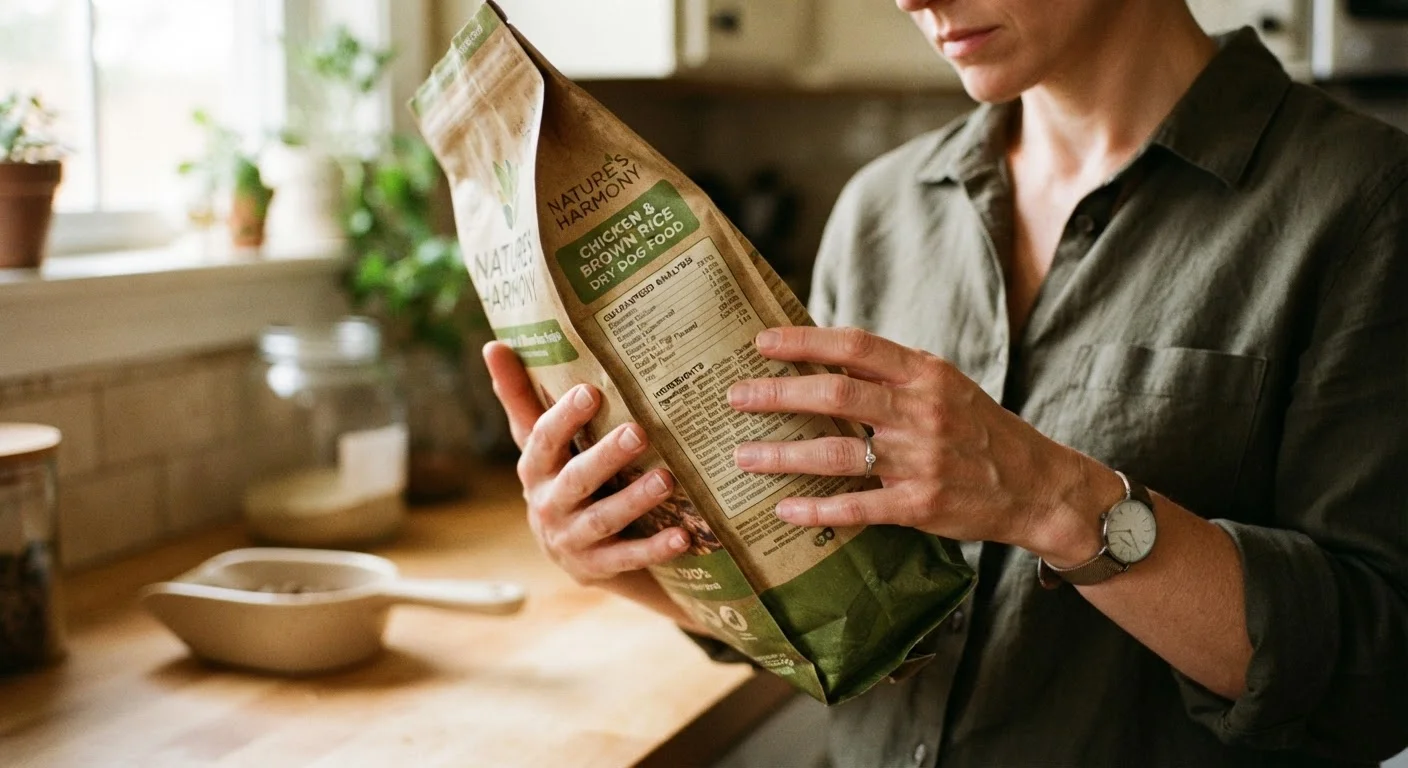
The Five Required Elements on Every Pet Food Label
Federal and state regulations require every commercially sold pet food to carry five core elements: the product name, the net quantity of contents, the manufacturer's name and address, the ingredient list, and the guaranteed analysis. A nutritional adequacy statement is also required for foods making a 'complete and balanced' claim. Each of these has a specific meaning — and knowing what to look for in each helps you move past the front-of-bag marketing.
The product name itself is regulated. If a protein like 'chicken' is the primary name, it must make up at least 70% of the total product (the so-called 95% rule applies to dry weight). Terms like 'dinner,' 'entrée,' or 'formula' drop that threshold to 25%. A phrase like 'with chicken' requires only 3%, and 'chicken flavor' requires only a detectable amount. This single distinction can shift your perception of how protein-rich a product actually is.
95%
Minimum named-ingredient threshold for product name rule
Under AAFCO's 95% rule, a product named 'Beef for Dogs' must be at least 95% beef by dry weight — excluding water used in processing.
3%
Minimum ingredient content for 'with' label claims
AAFCO guidelines require only 3% of a named ingredient when the product uses phrasing like 'with chicken,' a much lower bar than the primary name rule.
4
Minimum nutrients listed in guaranteed analysis
Every complete pet food label must list at least crude protein, crude fat, crude fiber, and moisture — though manufacturers may voluntarily include additional nutrients.
How to Read the Ingredient List
Ingredients are listed in descending order by pre-cooking weight, which sounds straightforward — but moisture content complicates it significantly. A whole chicken ingredient may weigh more than oats before processing simply because it contains water. After cooking removes that moisture, the relative contribution of each ingredient changes. This is why a food can legitimately list 'chicken' first while still being largely grain- or starch-based by dry weight.
Watch for ingredient splitting, a practice where a single ingredient is divided into sub-forms to push it lower on the list. For example, 'corn,' 'corn meal,' and 'corn gluten meal' listed separately may collectively represent more of the diet than the first-listed protein. This isn't illegal, but it's worth recognizing. For a broader look at how this compares to human food labeling practices, see how human nutrition labels work.
A Quick Check for Ingredient Splitting
When scanning an ingredient list, mentally group all forms of the same base ingredient — such as 'peas,' 'pea protein,' and 'pea starch' — and consider their combined position. If multiple forms of a single ingredient appear within the first five items, that ingredient likely plays a larger role in the diet than any single listing suggests. This doesn't make a food inferior, but it gives you a more accurate picture of its actual composition.
The Guaranteed Analysis: What the Numbers Mean
The guaranteed analysis panel lists four nutrients at minimum: crude protein (minimum), crude fat (minimum), crude fiber (maximum), and moisture (maximum). The word 'crude' refers to the method of chemical measurement, not quality. These are not precise amounts — they are upper or lower bounds, so the actual nutrient content in the bag may differ from what's printed.
Comparing guaranteed analyses between wet and dry foods requires an extra step. Because wet foods contain far more moisture (often 75–80% versus 10% in dry foods), you need to convert both to a dry matter basis to make a meaningful comparison. Divide the listed nutrient percentage by (100 minus the moisture percentage), then multiply by 100. This gives you the nutrient level as if all the water were removed. For more on how food format affects nutrient delivery, see how dry and wet food compare.
AAFCO Statements and Life Stage Claims
The AAFCO nutritional adequacy statement is arguably the most important line on the label. It tells you three things: which species the food is intended for, which life stage it covers (growth, adult maintenance, reproduction, or all life stages), and how adequacy was determined — by formulation to meet AAFCO nutrient profiles, or by actual feeding trials.
A food labeled for 'all life stages' must meet the most demanding nutrient levels — those required for growth and reproduction. This means it may contain higher calcium, phosphorus, and calorie levels than an adult-only pet actually needs. Conversely, a food labeled for 'adult maintenance' has not been validated for puppies or kittens and should not be fed to them as a sole diet. Always match the life stage on the label to your specific animal. These details interact directly with many of the misconceptions covered in our article on common pet nutrition myths.
What Labels Are Not Required to Tell You
Regulations set a floor, not a ceiling of transparency. Labels are not required to disclose the exact percentage of each ingredient, the geographic source of ingredients, whether ingredient quality varies batch to batch, or the actual caloric density in all cases (though calorie content statements are increasingly common). Marketing terms like 'premium,' 'holistic,' 'human-grade,' and 'gourmet' have no regulatory definitions in pet food and carry no enforceable nutritional standard.
'Natural' has a limited AAFCO definition but is not synonymous with safe, complete, or superior in nutrition. Understanding what isn't regulated is as useful as understanding what is. For additional context on label transparency gaps, what manufacturers aren't required to disclose explores the subject in further depth.
This article is for general informational purposes only and is not a substitute for professional veterinary advice. Always consult a licensed veterinarian regarding your specific pet's dietary needs.