How Each Method Actually Moves Energy
Wired charging is the simpler of the two to explain. Electricity flows from a wall adapter through a cable directly into your phone's charging port, where a small chip called a charging controller regulates the flow to match what your battery needs at any given moment. It's a closed, direct circuit — energy goes in with very little wasted along the way.
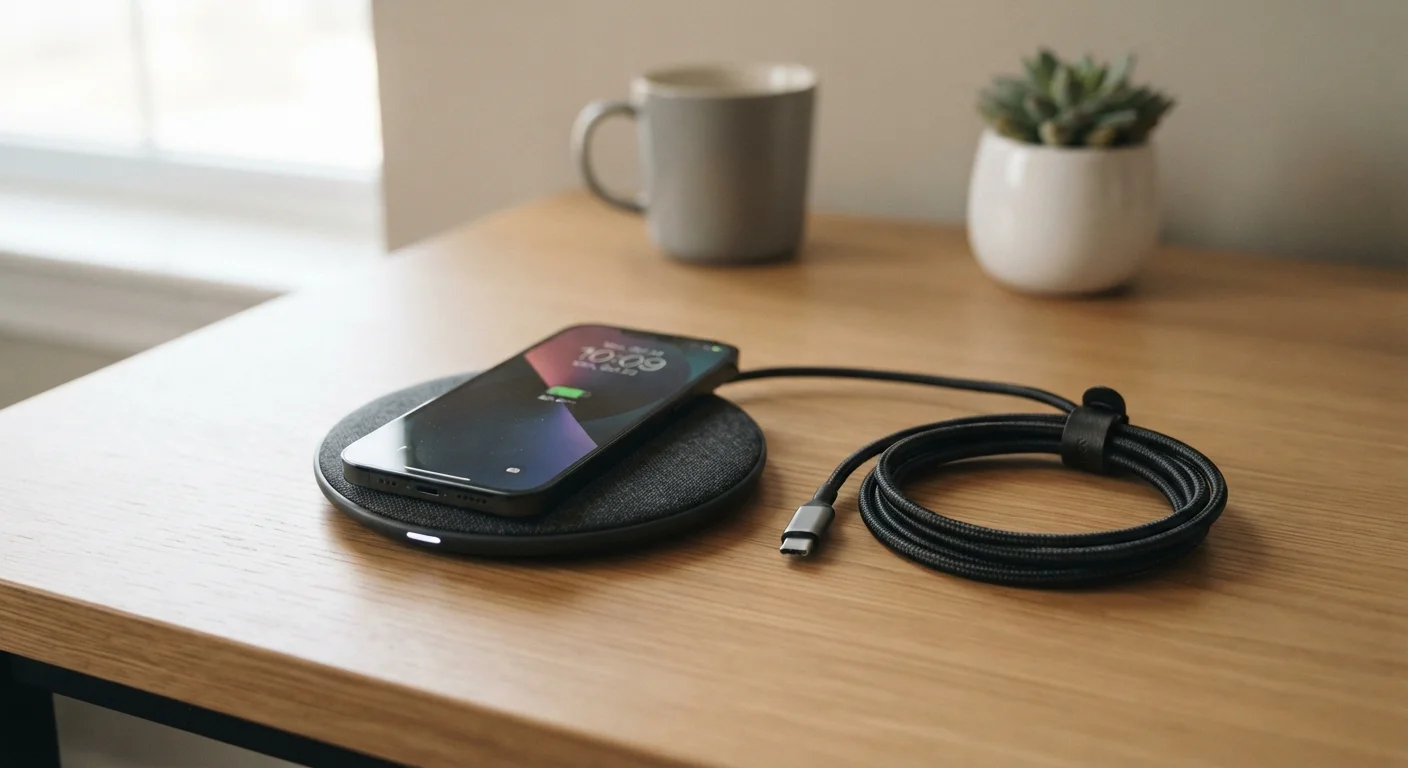
Wireless charging works through a principle called electromagnetic induction. Your charging pad contains a coil of wire. When electricity passes through it, that coil generates a fluctuating magnetic field. A second coil inside your phone picks up that field and converts it back into electrical current. No physical contact required — but that conversion process has a cost.
Because the energy has to jump across a small air gap and be converted twice, wireless charging is inherently less efficient. Studies and manufacturer data generally show wireless transfers operating at around 80–85% efficiency under ideal conditions, compared to wired transfers that can exceed 90%. The missing energy doesn't disappear — it becomes heat, which is felt in both the pad and the phone during a session. For a deeper look at what heat does to your battery cells over time, see our guide on the hidden life of a lithium-ion battery.
| Criterion | Wired Charging | Wireless Charging |
|---|---|---|
| Energy transfer method | Direct electrical circuit | Electromagnetic induction |
| Typical efficiency | ~90%+ | ~80–85% |
| Charging speed | Faster (up to 45W+) | Slower (typically 5–15W) |
| Heat generated | Lower during transfer | Higher due to conversion loss |
| Convenience | Requires cable connection | Drop-and-go, no cable needed |
| Device alignment needed | No | Yes — coil positioning matters |
| Long-term battery impact | Minimal heat wear | Slightly more heat wear over time |
What the Efficiency Gap Means in Practice
The efficiency difference translates most visibly to charging speed. A modern wired fast-charger can deliver 25W, 45W, or more directly to your device. Most mainstream wireless chargers operate between 5W and 15W, though higher-wattage wireless standards exist on select devices. The practical outcome: wired charging can refill a depleted battery in roughly half the time of wireless in many scenarios.
~85%
Typical wireless charging efficiency
Energy conversion losses in inductive charging mean roughly 15% of drawn power becomes heat rather than stored charge.
2×
Speed advantage of fast wired charging
In many real-world tests, fast wired chargers can refill a smartphone battery roughly twice as fast as a standard wireless pad.
For battery longevity, heat is the more important variable. Lithium-ion cells degrade faster when regularly exposed to elevated temperatures during charging. Wireless pads tend to run warmer than wired sessions, particularly if the phone isn't perfectly aligned with the coil. That said, the difference in long-term wear between the two methods is small for most users — modern phones include thermal management systems that throttle charging when things get too warm. For more on how overnight charging habits interact with these systems, the article on charging myths around leaving devices plugged in overnight covers the nuances well.
Choosing the Right Method for Your Routine
The honest answer is that for most people, both methods are perfectly fine when used thoughtfully. Here's a practical way to think about it:
- Wired charging makes sense when you're in a hurry, traveling, or want the most reliable, fastest refill available.
- Wireless charging suits a nightstand or desk setup where your phone sits idle for hours anyway — the slower speed doesn't matter if you have the time.
One thing worth avoiding: using your phone intensively while it's sitting on a wireless pad. The combination of processing heat and charging heat can push temperatures higher than either would alone.
Alignment also matters with wireless. Many pads have a sweet spot for the charging coil, and being slightly off-center can cut efficiency noticeably or stop charging altogether. If your wireless pad feels inconsistent, repositioning the phone is the first thing to try.
The physics of charging share something in common with the physics of wireless signals — both involve energy moving through space with the potential for loss and interference. If you're curious how those same principles play out with your home network, our article on Wi-Fi signal loss and dead zones explains the parallels clearly.