What's Actually Happening When You Charge
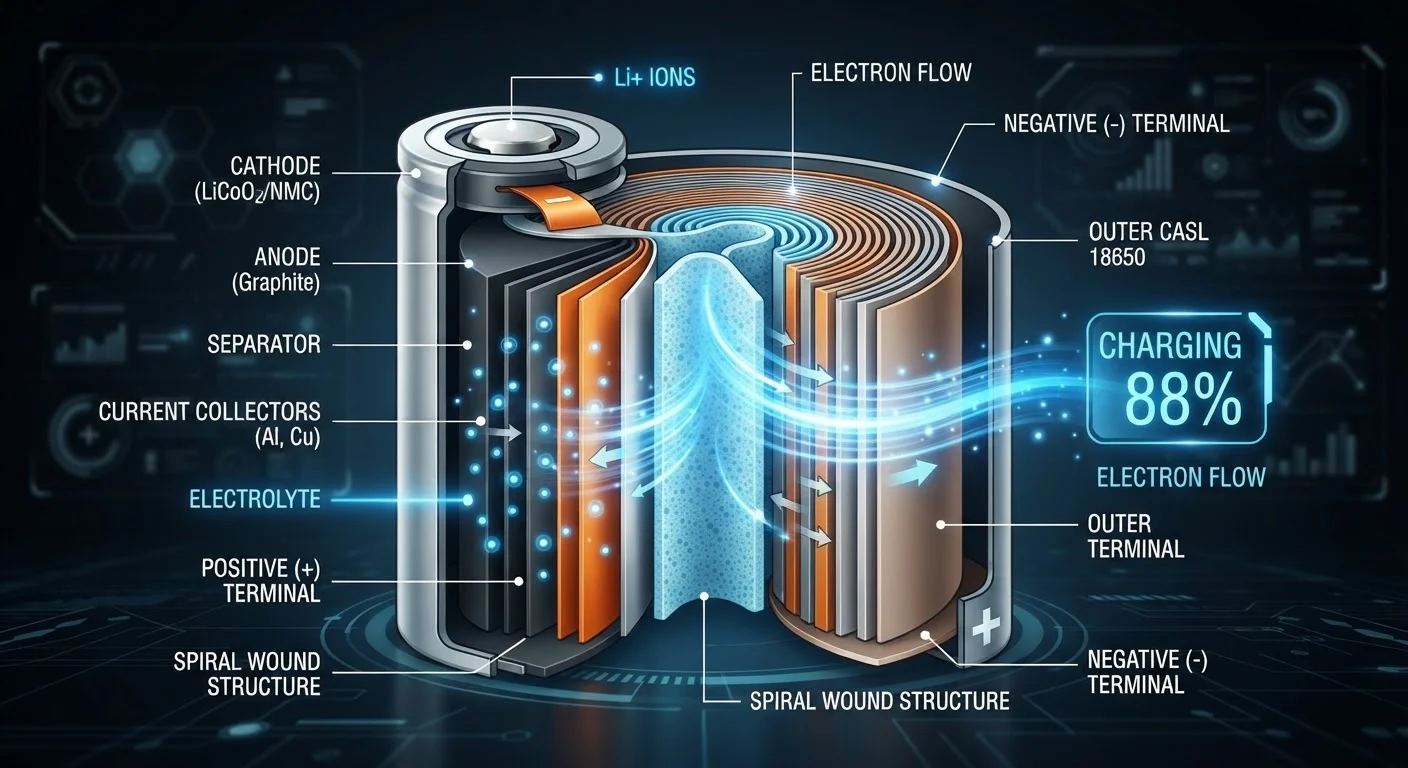
Every time you plug in your phone or laptop, you're triggering a controlled electrochemical reaction. Lithium ions leave the cathode, travel through the electrolyte, and embed themselves in the graphite anode — a process called intercalation. When you unplug and start using the device, the ions make the return trip, and that movement generates the electrical current powering your screen, processor, and radio.
This is fundamentally different from a car's lead-acid battery or the alkaline cells in a TV remote. Lithium-ion chemistry offers a far better ratio of energy stored to weight, which is why it dominates portable electronics. The trade-off is that the chemistry is sensitive — to temperature, to charge levels, and to time.
For a deeper look at how charging methods differ and what they mean for battery health, see how wired and wireless charging compare.
~80%
Capacity retained after 300–500 full charge cycles
This is the general industry benchmark cited by major device manufacturers for lithium-ion cell longevity under typical use conditions.
25°C
Optimal storage temperature for lithium-ion cells
Battery researchers widely cite room temperature (around 25°C / 77°F) as the sweet spot for minimizing long-term capacity loss during storage.
20–80%
Recommended daily charge range to reduce stress
Electrochemical studies on lithium-ion cells suggest that staying within this range can meaningfully slow electrode degradation over time.
Why Batteries Inevitably Wear Out
Capacity fade is the gradual, permanent loss of a battery's ability to hold a full charge. It happens through several mechanisms working simultaneously.
- Electrolyte decomposition: The liquid electrolyte slowly reacts with electrode surfaces, forming a resistive layer called the solid electrolyte interphase (SEI). Over time, this layer thickens and consumes lithium ions permanently.
- Electrode cracking: Ions physically expand and contract the electrode material as they enter and leave. Repeated cycling causes microscopic cracks, reducing the surface area available for reactions.
- Lithium plating: Charging too fast, especially in cold conditions, can cause lithium to deposit on the anode as metallic lithium rather than intercalating properly. These deposits, called dendrites, can create internal short circuits.
Battery wear is also a factor in overall device performance. Smartphone slowdowns are often partly attributable to a weakened battery that can no longer sustain peak processor performance.
Slow Charging Is Gentler on Your Battery
Fast charging is convenient, but it generates more heat and pushes higher currents through the cell — both of which accelerate wear. Whenever time allows, using a standard-speed charger rather than a high-wattage fast charger is a simple habit that can reduce long-term stress on the battery.
The Role of Heat and Charge Levels
Of all the variables you can influence, temperature matters most. Heat accelerates every degradation mechanism described above. A battery regularly exposed to high temperatures — whether from a hot car, direct sunlight, or intensive processor loads — ages measurably faster than one kept cool.
Charge level also matters. Electrochemical research consistently shows that lithium-ion cells experience less stress when kept in a moderate state of charge. Very high charge states (near 100%) and very deep discharges (near 0%) both place additional strain on electrode materials. This is why many device manufacturers now build in charge-limiting features.
Charge-Limiting Features Are Worth Enabling
Many smartphones, laptops, and tablets now offer settings that cap charging at 80% or use learned schedules to minimize time at full charge. These features are based on real electrochemical principles, not marketing. If your device offers one, it's generally worth turning on — especially if you frequently charge overnight.
For broader strategies to extend the useful life of devices you already own, practical device longevity habits are worth building early.
What Battery Health Percentages Really Mean
Most modern smartphones and laptops expose a battery health metric — typically a percentage showing remaining maximum capacity relative to when the battery was new. A reading of 85%, for example, means the battery can now store only 85% of its original energy. That translates directly to shorter time between charges.
These figures are estimates calculated by the device's battery management system (BMS), a small onboard computer that monitors voltage, current, and temperature. The BMS also enforces safety limits — cutting off charging when the cell is full and throttling power delivery if the battery overheats or drops dangerously low.
Understanding these numbers helps set realistic expectations. A battery at 80% health isn't broken — it's a normal, aging electrochemical system doing its job. Knowing when degradation has progressed enough to consider a battery replacement (rather than a whole new device) is genuinely useful consumer knowledge. For automotive context, the same principles apply to recognizing signs of a weakening car battery.