
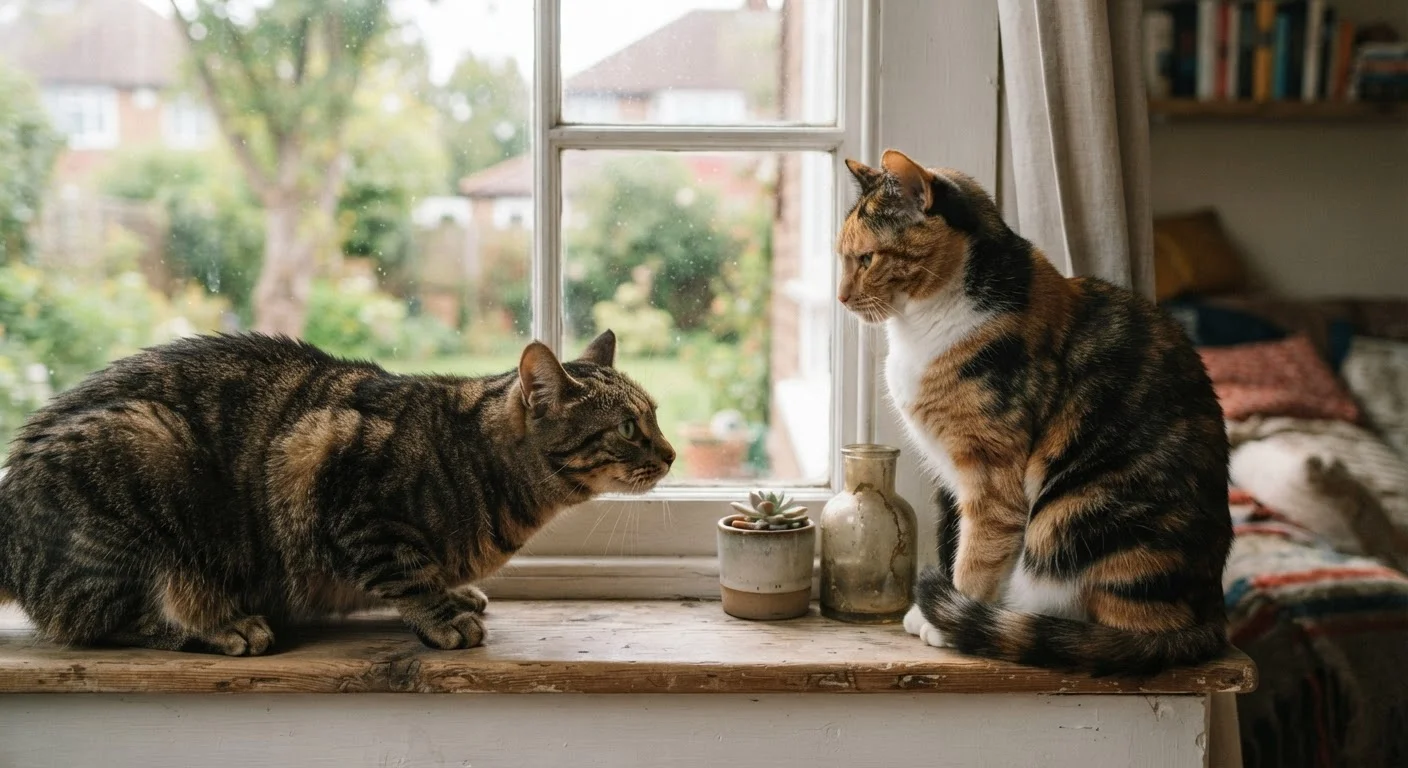
Why Cats Are Wired for Territory
Unlike dogs, which evolved as pack animals, domestic cats descend from largely solitary ancestors. In the wild, a cat's territory represents survival - it determines where the animal hunts, rests, and mates. That evolutionary programming doesn't disappear just because a cat lives indoors with two siblings and a food bowl.
Territory for cats isn't simply about physical space. It's layered: cats recognize and defend core areas (sleeping and eating spots), home ranges (areas they patrol regularly), and peripheral zones that overlap with other animals. When multiple cats share a home, these invisible maps collide, and negotiating them requires time, structure, and often deliberate human support.
Understanding this biological baseline is the first step. Conflict in a multi-cat home is rarely about personality clashes alone - it's about how space, resources, and social hierarchy are being managed. See our visual guide to cat body language to understand how cats signal discomfort before conflict escalates.
When introducing cats, swap bedding between the two animals for several days before any face-to-face contact. This scent exchange allows each cat to process the other's presence without the pressure of a physical encounter.
Cats rely on olfactory information more than visual cues when assessing safety. Gradual scent exposure reduces the novelty - and therefore the threat level - of a new animal before visual introduction occurs.
Position litter boxes against walls, not in corners. A cat trapped in a corner while using the box cannot escape a threat - and that vulnerability alone can cause avoidance that looks like a litter problem but is actually a safety concern.
Elimination is a moment of vulnerability for cats. Feeling able to exit quickly reduces stress and makes box-sharing in multi-cat homes significantly more manageable.
Common Signs of Territorial Conflict
Territorial tension doesn't always look like a full cat fight. Many of the most telling signs are subtle and easy to miss or misread.
- Blocking: One cat physically prevents another from accessing a room, doorway, litter box, or food station - sometimes just by sitting in the path and staring.
- Urine marking: Spraying vertical surfaces is a clear territorial signal, even in cats that are spayed or neutered.
- Redirected aggression: A cat agitated by something outside (like a stray seen through a window) may lash out at a housemate instead.
- Hiding or withdrawal: A cat that suddenly spends most of its time under the bed may be losing a territorial negotiation silently.
- Over-grooming or appetite changes: Chronic stress from conflict can manifest physically. These shifts also overlap with illness - subtle behavioral changes in cats can signal health problems worth ruling out with a vet.
For a deeper look at distinguishing play from genuine aggression, see our article on aggression vs. rough play in cats and dogs.
Don't Ignore Subtle Withdrawal
A cat that quietly disappears to another room and stops engaging with housemates is often under significant stress - and stress in cats can progress to physical illness if unaddressed. Hiding and reduced social engagement should prompt a closer look at the household dynamic and, when persistent, a veterinary check-up to rule out underlying health issues.
What Triggers Territory Disputes
Several predictable factors increase the likelihood of territorial conflict between cats sharing a home.
1 in 5
Multi-cat households reporting chronic conflict
Behavioral surveys suggest a notable proportion of multi-cat homes experience ongoing tension, with resource competition as a primary driver.
N+1
Recommended litter boxes per household
Veterinary behaviorists generally recommend one litter box per cat plus one additional to reduce competition and stress-related elimination problems.
Resource Scarcity
When cats must compete for food bowls, litter boxes, or desirable resting spots, tension rises. The general veterinary guideline - one litter box per cat plus one extra - exists precisely because competition over elimination areas is a frequent flashpoint.
New Additions to the Household
Bringing a new cat home disrupts established spatial hierarchies. Even a confident, friendly resident cat can become aggressive when its core territory is suddenly occupied by a stranger. A structured introduction process is essential - our guide on introducing a new pet to a resident animal walks through this step by step. If you're still in the early settling-in phase, your new pet's first 30 days at home offers a broader foundation.
Environmental Changes
Moving furniture, renovating, or even bringing in new scents can unsettle a cat's mental map of its territory and temporarily increase tension between housemates.
Hormonal Influences
Intact cats are significantly more likely to mark territory and engage in aggressive disputes. Spaying and neutering reduces (though does not eliminate) these behaviors.
How to Reduce Tension in a Multi-Cat Home
The most effective interventions are environmental. Most cats don't need behavioral medication or rehoming - they need their living space restructured to reduce competition and increase predictability.
Increase Vertical Space
Cats naturally stratify socially using height. Cat trees, shelves, and elevated perches allow multiple cats to occupy the same room without direct confrontation. A lower-ranking cat can move up; a dominant one can claim a top perch. Everyone gets space.
Multiply Resources and Separate Them
Place food bowls, water sources, and litter boxes in multiple locations - ideally out of sight of one another. A cat that can be cornered at its food bowl will eat in a state of stress, which compounds tension over time.
Use Scent to Your Advantage
Cats communicate heavily through scent. Synthetic feline facial pheromone diffusers are one tool some owners use to promote a sense of familiarity in a shared space, though individual responses vary. Consult your veterinarian before relying on any product as a primary solution.
Provide Individual Retreats
Each cat should have at least one space it can access that other cats typically don't use - a carrier with the door removed, a specific shelf, or a room with intermittent access. Predictable alone-time reduces cumulative stress.
Keep Feeding Schedules Consistent
Routine reduces uncertainty. Cats that know when and where they'll be fed are less likely to guard or compete over resources.
Start With the Environment Before Behavior
Before assuming two cats simply can't get along, audit your home's layout. Are resources clustered in one area? Is there a single bottleneck - a hallway, doorway, or staircase - that one cat controls? Many conflicts dissolve once cats have genuinely separate routes and rest areas. Restructuring the environment is almost always the right first step.
When to Involve a Veterinarian or Behaviorist
Not all territorial conflicts resolve with environmental adjustments alone. Seek professional guidance when:
- Aggression results in injury to any cat in the household
- One cat is consistently unable to access food, water, or the litter box
- A previously harmonious pair suddenly begins fighting - this can signal an underlying medical issue in one cat
- Urine marking persists despite environmental changes
- Stress-related symptoms (over-grooming, appetite loss, hiding) are ongoing
A veterinarian can rule out medical causes for behavioral changes and, if needed, refer you to a certified applied animal behaviorist (CAAB) or a veterinary behaviorist (Dip ACVB) for a structured behavior modification plan. These professionals can assess the full social dynamic in your home and recommend interventions tailored to your specific cats.
This article is for general informational and educational purposes only. It is not a substitute for professional veterinary advice, diagnosis, or treatment. Always consult a licensed veterinarian for guidance specific to your pet's health and behavior.
Outdoor Access and Territory
Cats with access to outdoor space may experience a different kind of territorial stress - encounters with neighborhood cats near windows or entry points can agitate indoor cats and redirect that tension onto housemates. If this is a factor in your home, see our overview of health trade-offs for indoor vs. outdoor cats for broader context.