
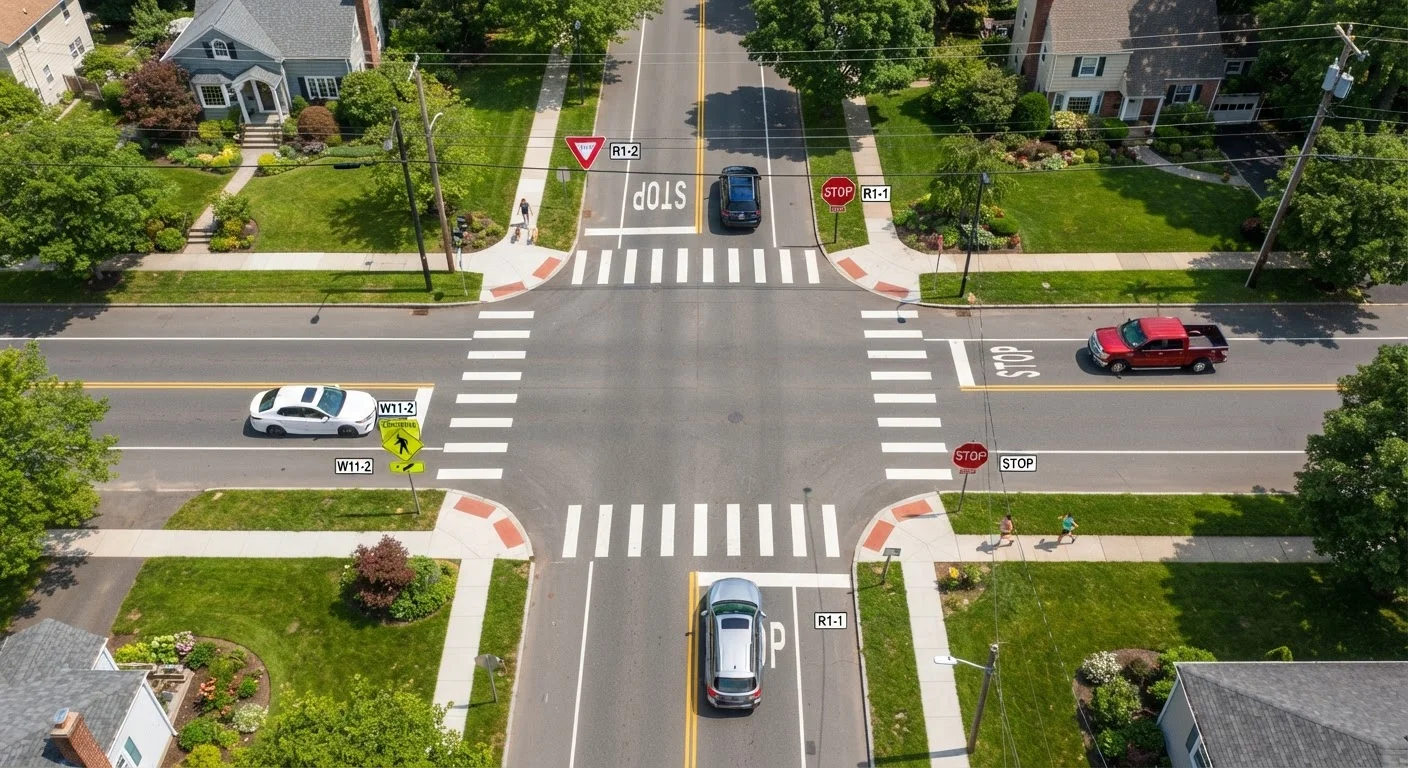
How Traffic Signs Are Organized
The U.S. traffic sign system divides signs into three broad categories based on their function: regulatory, warning, and informational (guide). Color, shape, and placement all carry meaning before a driver reads a single word.
| Octagon shape | Stop signs only (MUTCD (Manual on Uniform Traffic Control Devices)) |
| Inverted triangle shape | Yield signs only (MUTCD) |
| Diamond shape | Warning signs only (MUTCD) |
| Regulatory sign color | White background with black or red markings (MUTCD) |
| School zone sign shape | Pentagon (five-sided) (MUTCD) |
| Guide/informational sign color | Green (highway), blue (services), brown (recreation) (MUTCD) |
Shape is especially useful at a glance. An octagon means stop-no other sign uses that shape. An inverted triangle means yield. Diamond shapes are reserved exclusively for warnings. Knowing these shapes lets drivers respond correctly even when visibility is limited. For a broader look at foundational road rules, see Road Safety from Day One.
Regulatory Signs: What You Must Do
Regulatory signs carry the force of law. Ignoring them can result in citations, collisions, or both. Here are the ones most frequently misunderstood:
- Stop: Come to a complete stop before the stop line, crosswalk, or intersection edge. A rolling slow-down does not satisfy a legal stop.
- Yield: Slow down and give the right-of-way to traffic already in the intersection or crosswalk. Stop only if necessary-but you must stop if traffic is present.
- Do Not Enter / Wrong Way: These two signs often appear together on one-way roads and divided highway ramps. Either sign means you are facing oncoming traffic if you proceed.
- No U-Turn: Self-explanatory, but drivers sometimes confuse it with a No Left Turn sign. The U-Turn symbol shows a looping arrow; the left-turn symbol shows a single arrow curving left.
- Speed limit: The posted number is a maximum under ideal conditions-not a target speed. Conditions such as weather, traffic density, and visibility may require driving more slowly.
Regulatory sign
A sign that establishes a legal requirement or restriction drivers must obey. Regulatory signs are typically white with red or black text and carry the same authority as statutes.
Warning sign
A diamond-shaped yellow sign that alerts drivers to a hazard, change in road conditions, or situation requiring increased caution ahead. Compliance is not legally mandated, but failing to adjust speed or behavior can still result in liability.
Advisory speed plate
A white rectangular placard mounted below a curve warning sign showing the recommended safe speed for navigating that specific curve. It is not a legally posted speed limit, but reflects engineering analysis of the curve.
Right-of-way
The legal principle that determines which driver or pedestrian has priority to proceed through an intersection or crossing. Yielding right-of-way means slowing or stopping to let the priority user pass first.
Channelizing island
A raised or painted area in a roadway that guides traffic into the correct lanes or around obstacles. Drivers must keep to the designated side indicated by signs or pavement markings.
Crossbuck
The white X-shaped sign posted at railroad grade crossings. It means drivers must yield to any approaching train and is legally equivalent to a yield sign in most states.
Warning Signs: What to Prepare For
Yellow diamond signs alert drivers to changing road conditions or hazards ahead. They do not prohibit action-they prompt a change in behavior. Common examples include:
- Curve / Winding Road: Indicates the road changes direction. An advisory speed plate mounted below (in white) suggests a safe cornering speed for that curve.
- Merge / Lane Ends: These are distinct. A merge sign means two lanes are combining; a lane ends sign means your lane disappears and you must move over. Misreading the difference is a common contributor to highway conflicts. Learn more about common merging mistakes.
- Pedestrian / School Crossing: Pentagonal (five-sided) school zone signs are unique in shape. Both types require reduced speed and heightened awareness.
- Slippery When Wet: A car with wavy skid lines. This sign appears where the road surface becomes especially hazardous in rain-reduce speed before reaching that stretch, not after.
- Railroad Crossing (RxR): The round yellow advance warning sign appears before the crossbuck at the tracks. Treat it as a prompt to scan, slow, and be prepared to stop.
Orange Signs Mean Active Work Zones
Orange replaces yellow in temporary traffic control zones such as construction sites. Speed limits posted on orange signs carry the same legal authority as permanent signs, and fines are often doubled in active work zones. Treat flagger instructions as equivalent to traffic signals-they have legal authority to direct traffic flow.
Signs Drivers Most Often Misread
Even experienced drivers misinterpret certain signs. These deserve special attention:
- Flashing yellow arrow (turn signal): Means a turning movement is permitted but you must yield to oncoming traffic and pedestrians-it is not a protected green turn.
- White regulatory vs. yellow warning rectangles: A white rectangular sign is regulatory (you must comply). A yellow rectangular sign is a warning or advisory. The color distinction matters legally.
- Shared-use path crossing: A green or blue icon of a cyclist and pedestrian indicates a path crossing the road-drivers must yield to both groups.
- Keep Right of Divider (orange or white arrow on black): Seen at medians and channelizing islands. Drivers sometimes steer left of these, creating a head-on risk.
Building accurate sign recognition is part of broader defensive driving habits that help anticipate hazards before they become emergencies. For a comprehensive look at road rules and risk factors, visit our guide to safe driving from all angles.