
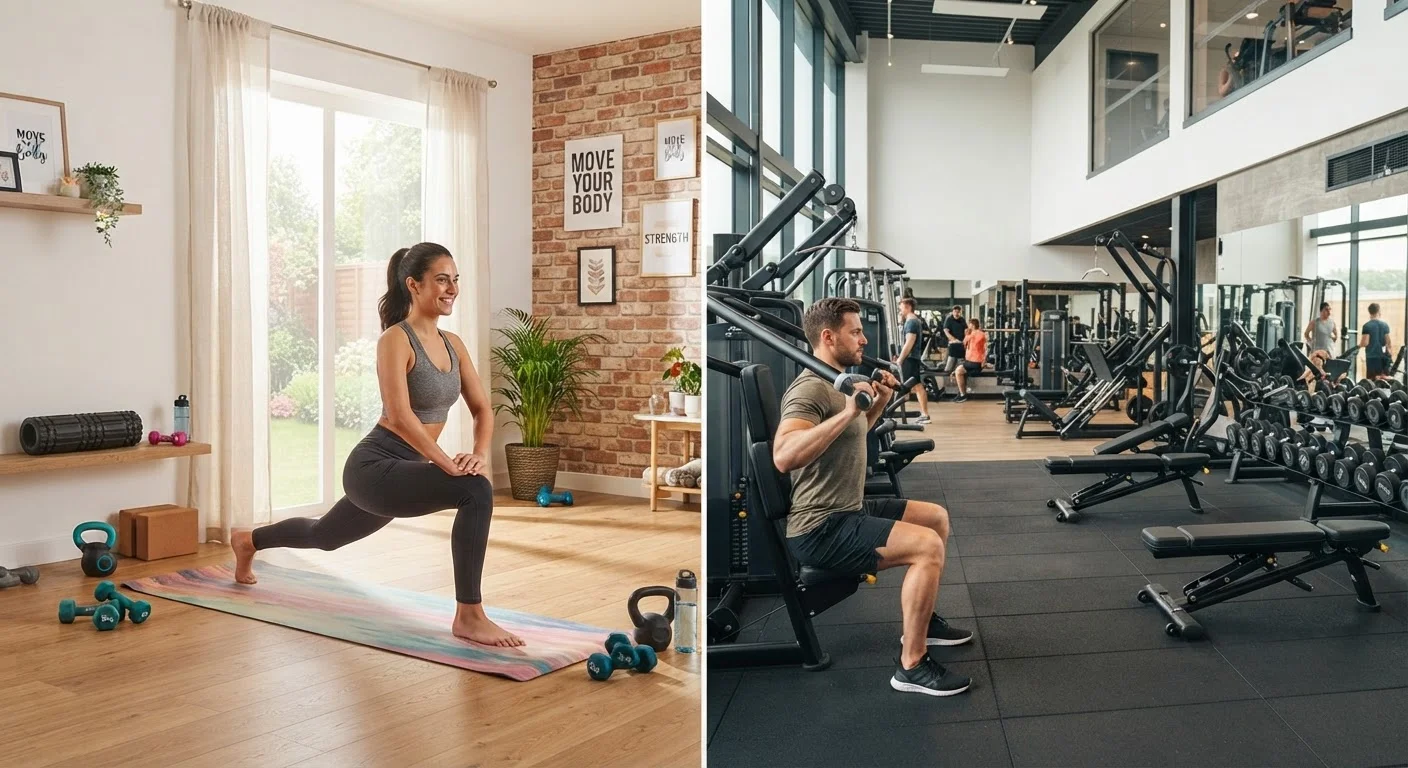
Why the Debate Matters Less Than You Think
The home-vs.-gym conversation often gets treated as a binary choice with a right answer. In practice, research consistently shows that the best training environment is the one you'll actually use. A well-equipped gym you visit twice a month beats a home setup you use daily - and vice versa.
That said, the practical differences between these settings are real and worth understanding. Factors like cost, access to equipment, scheduling flexibility, and motivation all influence long-term adherence - which is the single strongest predictor of fitness outcomes. See also our look at common fitness myths for context on what the evidence actually says about exercise habits.
| Home Workouts | Gym Training | |
|---|---|---|
| Monthly Cost | Low (after equipment purchase) | Ongoing membership fees |
| Convenience | High - no commute or hours | Dependent on location and schedule |
| Equipment Variety | Limited by space and budget | Broad - machines, free weights, cardio |
| Accountability | Self-directed only | Social environment, classes, trainers |
| Privacy | Complete | Shared public space |
| Advanced Strength Training | Challenging without heavy equipment | Well-supported with full rack setups |
| Flexibility of Hours | Anytime | Tied to facility hours |
The Case for Home Workouts
Home training removes friction. There's no commute, no membership fee, no waiting for equipment, and no set hours. For people with demanding schedules, young children, or irregular work patterns, these advantages are substantial - they lower the barrier to actually starting a session.
The equipment floor has also dropped significantly. Resistance bands, adjustable dumbbells, pull-up bars, and a yoga mat can support a wide range of effective training styles. For those interested in structured bodyweight progressions, our introduction to bodyweight training outlines how to build a complete routine without any equipment at all.
The main limitations are real: space constraints, limited load ranges for heavy strength work, and the absence of external accountability. Motivation can stall without a structured environment, and some people simply find it harder to mentally separate a workout space from a living space.
Start Small to Build the Habit
Whether you're training at home or at the gym, research on habit formation suggests that starting with shorter, more frequent sessions is more effective than infrequent long ones. Even 20 minutes done consistently outperforms a 90-minute session done rarely. Design your environment - lay out workout clothes, clear a space, schedule the time - to reduce the mental effort required to begin.
The Case for Gym Training
Gyms provide equipment breadth that most home setups can't match - barbells, cable machines, squat racks, cardio equipment, and resistance machines across a wide load range. For those with specific strength or hypertrophy goals, this variety matters. Progressive overload (gradually increasing resistance over time) is easier to apply with access to incremental weight changes.
There's also an underappreciated social element. Being around others who are exercising can increase effort and commitment - a phenomenon sometimes called the social facilitation effect. Many people also find that the act of traveling to a gym creates a mental transition into workout mode. Group fitness classes, personal training, and peer accountability are gym-specific advantages that some individuals find essential for consistency.
Cost and scheduling are the obvious downsides. Monthly membership fees add up, and gym availability is tied to operating hours. Crowding during peak times can also affect workout quality. For those exploring different training formats available at gyms, our guide to exercise formats explains what each style is designed to achieve.
Making the Choice That Fits Your Life
A few honest questions can clarify the decision more than any blanket recommendation:
- What is your realistic budget? Gym memberships vary widely in cost. A home setup requires upfront investment but no recurring fees.
- When do you train? Early mornings, late nights, or irregular schedules often favor home setups. If your peak motivation aligns with gym hours, that barrier dissolves.
- What are your specific goals? General fitness and cardiovascular health are achievable in both settings. Advanced powerlifting or Olympic weightlifting typically requires gym access.
- What motivates you? Some people thrive in solitude; others need social energy. Neither preference is wrong.
A hybrid approach - home training on busy days, gym sessions when time permits - works well for many people and doesn't require an all-or-nothing commitment. If you're building a walking habit as a complement to either setting, our piece on walking for fitness covers its genuine health value. And for a deeper look at how different exercise types affect the body, see strength training vs. cardio.
This article is for general informational purposes only and does not constitute medical or fitness advice. Consult a qualified healthcare or fitness professional before beginning a new exercise program, particularly if you have any health conditions or concerns.