
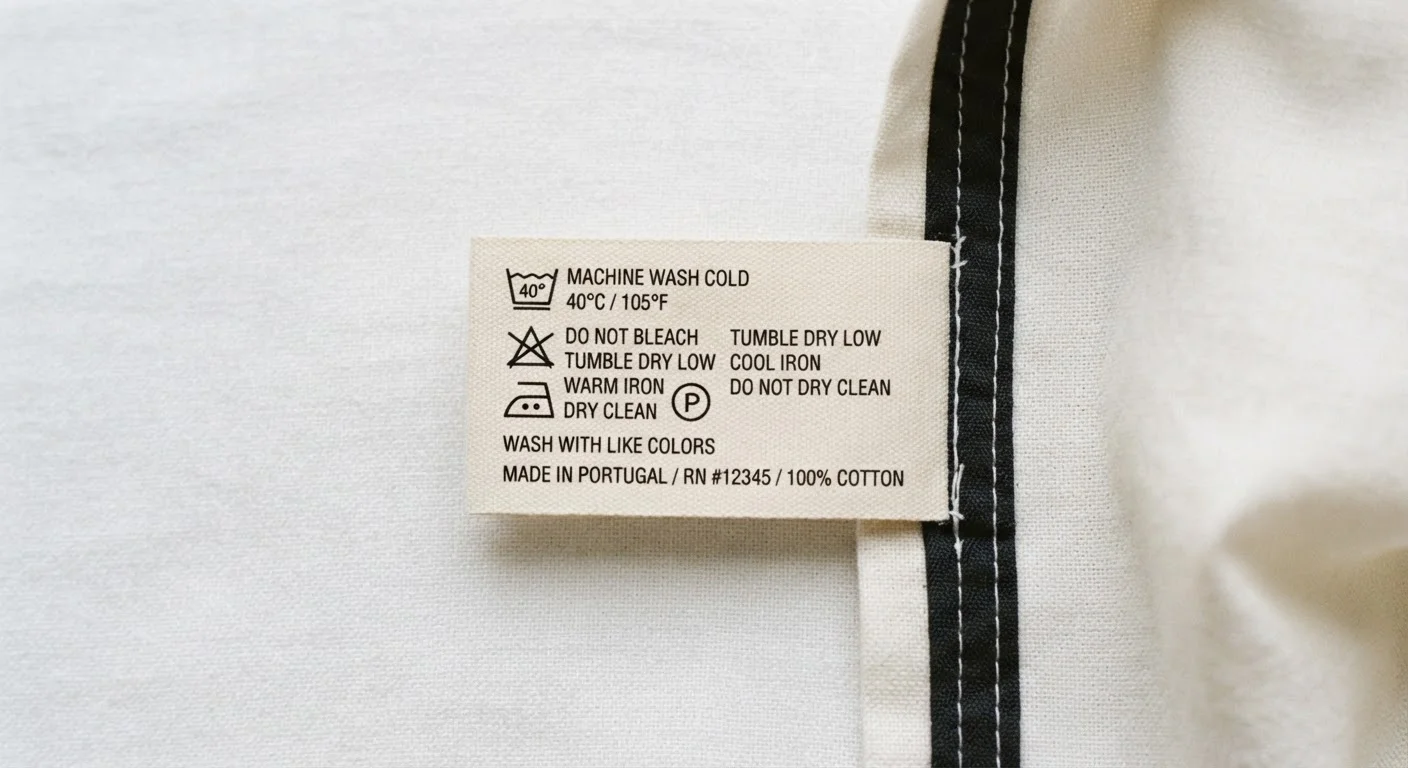
Why Care Labels Exist (and Why You Should Read Them)
That tiny folded tag stitched into your collar or side seam isn't just filler — it's a legally required set of instructions. In the United States, the Federal Trade Commission (FTC) mandates that most garments sold domestically include a permanent care label listing laundering instructions. The symbols used follow standards developed by the American Society for Testing and Materials (ASTM) and, internationally, by ISO and GINETEX, which is why the icons look similar across U.S. and imported clothing.
Ignoring those symbols is one of the most common reasons clothes shrink, fade, pill, or warp. Whether you're building a new wardrobe or just trying to keep your existing pieces in better shape, understanding the label is a foundational skill. For context on making deliberate wardrobe choices, see our closet audit guide.
| U.S. Care Label Requirement | Mandated by the FTC for most garments sold in the U.S. (FTC Care Labeling Rule) |
| Symbol Standard (U.S.) | ASTM D5489 (American Society for Testing and Materials) |
| International Symbol Standard | ISO 3758 / GINETEX (Global standard used in most imported clothing) |
| Core Symbol Categories | 5 — Washing, Bleaching, Drying, Ironing, Dry Cleaning |
| Temperature Unit on Labels | Celsius (°C), even on U.S. garments (Per ASTM and ISO standards) |
| Other Required Label Info | Fiber content and country of manufacture (FTC Textile and Care Labeling Rules) |
Decoding the Five Core Symbol Categories
Washing
The washtub icon represents machine or hand washing. A plain tub means machine wash is safe. A hand dipping into the tub means hand wash only. A number inside the tub (e.g., 30, 40, 60) indicates the maximum water temperature in Celsius. A single underline below the tub means use the permanent press cycle; two underlines mean gentle/delicate cycle. An X through the tub means do not wash at all — this item requires dry cleaning or spot treatment only.
Bleaching
A triangle governs bleach use. An empty triangle means any bleach is acceptable. A triangle with diagonal lines means use only non-chlorine (oxygen) bleach. An X through the triangle means do not bleach under any circumstances.
Drying
A square covers drying methods. A circle inside the square represents tumble drying; dots inside that circle indicate heat level (one dot = low, two = medium, three = high). An X over the circle means no tumble drying. Squares without a circle show line, drip, or flat drying instructions — a curved line at the top means hang to dry, three vertical lines mean drip dry, and a horizontal line across the middle means dry flat.
Ironing
The iron icon mirrors the approach for washing temperatures: dots inside indicate heat setting (one = low, two = medium, three = high). An X through the iron means do not iron. An X through steam lines under the iron means no steam.
Dry Cleaning
A circle alone means the item is dry-clean safe. Letters inside the circle (A, F, P, W) communicate which solvents a professional cleaner should use — this is information for the cleaner, not the consumer. An X through the circle means do not dry clean.
Permanent Press Cycle
A washing machine setting that uses warm water and a cool-down rinse to reduce wrinkles in synthetic or blended fabrics. Indicated on care labels by a single underline beneath the washtub symbol.
Delicate / Gentle Cycle
A low-agitation machine wash setting designed for fragile fabrics like lace, silk, or loosely knit items. Shown as two underlines beneath the washtub symbol.
Non-Chlorine Bleach
Also called oxygen or color-safe bleach, this is a gentler alternative to chlorine bleach that is less likely to strip dye or damage fibers. Indicated by a triangle with diagonal lines.
Dry Flat
A drying method where the garment is laid horizontally on a clean surface to prevent stretching, typically required for wool or knit items. Indicated by a square with a horizontal line through the middle.
Fiber Content
The percentage breakdown of fibers used to construct a fabric, such as 100% cotton or 80% wool / 20% nylon. U.S. law requires this information on all garment labels.
Dry Cleaning
A professional garment cleaning process that uses chemical solvents rather than water. Required for many structured, delicate, or specialty fabrics that would be damaged by conventional washing.
Fiber Content, Country of Origin, and What Else Is on the Tag
Beyond care symbols, U.S. labels are also required to list the fiber content (e.g., 100% cotton, 60% polyester/40% rayon) and the country of manufacture. Fiber content directly informs how you should care for the item — natural fibers like silk and wool are almost always more heat-sensitive than synthetics like nylon or polyester.
Some tags also carry RN (Registered Number) or WPL numbers, which are FTC-issued identifiers for the manufacturer or importer. These aren't care instructions, but they can help you trace a garment's origin if needed.
Understanding fabric composition also connects to how a piece fits and moves. For a deeper look at how construction and material affect wearability, check out our guide to fit versus size. And when you're ready to make intentional additions to your closet, building a wardrobe that reflects who you are is a great next step.
When There's No Label or It's Faded
If a care label is missing or illegible, check the fiber content if it's still visible — natural fibers generally call for cooler water and gentler cycles. When in doubt, hand washing in cool water and air drying flat is the safest default for most garments. For structured pieces like blazers or beaded items, professional dry cleaning is a prudent choice when the label is unclear.