Why Pattern Mixing Feels Risky (And Why It Doesn't Have to Be)
For a lot of people, the idea of mixing patterns feels like walking a tightrope — one wrong step and the whole outfit falls apart. That anxiety is understandable, but it usually comes from treating pattern mixing as a guessing game rather than a skill with learnable logic.
The truth is that pattern combinations either work or clash for specific, identifiable reasons. Once you understand those reasons, you stop relying on luck and start making deliberate choices. If your outfits have felt a little all-over-the-place recently, this breakdown of why outfits feel inconsistent is worth reading alongside this guide.
Start With Stripes as Your Mixing Neutral
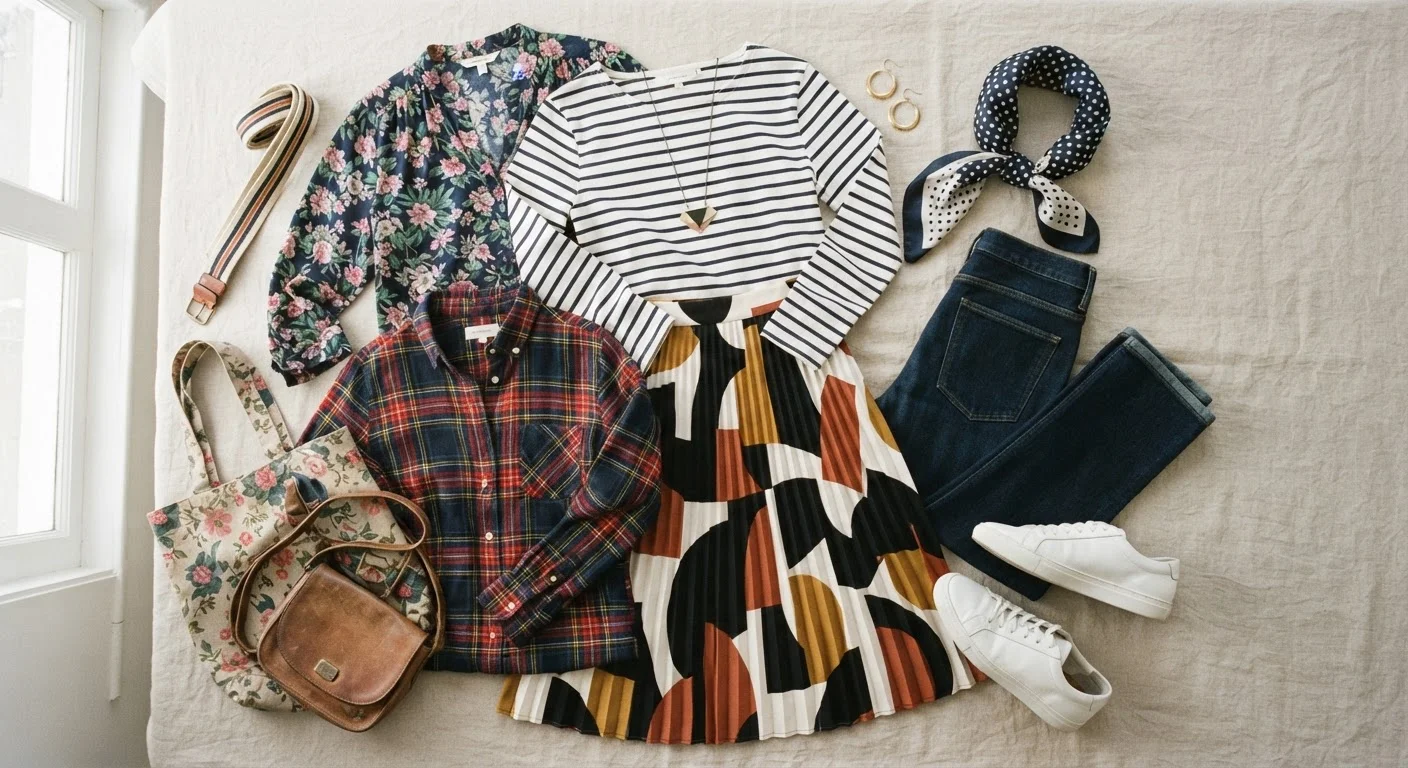
If pattern mixing feels intimidating, begin with a classic stripe as one of your two patterns — it's the most flexible print in a wardrobe. Stripes behave almost like a neutral, which means they play well with bolder, more organic patterns like florals or abstract prints. Master the stripe-and-one-other combination before adding a third pattern to the mix.
The Three Core Principles That Make It Work
1. Scale Contrast
The single most important variable in pattern mixing is scale — the relative size of the print. When two patterns share a similar scale, they compete visually and create noise. When their scales differ significantly, they complement each other. A large painterly floral paired with a narrow pinstripe is visually interesting. Two medium-sized prints of the same weight? Chaotic.
2. Color Cohesion
Patterns don't need to match — they need to relate. The most reliable bridge between two different prints is a shared color. If your plaid contains navy, cream, and rust, a floral that picks up even one of those tones will feel connected. For a deeper look at how colors interact and build harmony, color coordination principles every dresser should know are fundamental here.
3. Pattern Type Variation
Patterns fall into two broad families: geometric (stripes, checks, plaids, grids) and organic (florals, abstracts, animal prints, paisleys). Mixing one from each family almost always works better than doubling up within the same family. Two different florals can feel muddled; a floral and a plaid feel intentionally layered.
2–3
Ideal number of patterns per outfit
Most fashion educators and stylists suggest limiting combinations to two or three patterns to maintain visual coherence without sacrificing creativity.
3:1
Scale ratio for effective pattern contrast
A common guideline in visual design holds that patterns with a scale ratio of roughly 3:1 or greater create clear contrast rather than visual competition.
When Pattern Mixing Doesn't Work — And Why
Even with the best intentions, some combinations fall flat. Here's what usually goes wrong:
- Same scale, similar palette: Two midsize prints in similar tones have nothing to anchor them apart. The eye doesn't know where to land.
- Too many competing focal points: Every pattern wants attention. When three or more prints are all bold and large, the outfit has no visual hierarchy — no quiet moment for the eye to rest.
- No color thread: Patterns from completely different color families without a single shared anchor feel like two separate outfits stapled together.
Interestingly, many of the so-called "rules" around pattern mixing are more flexible than people assume. Some style rules are genuinely worth breaking — and pattern mixing is a space where confident experimentation often pays off.
Using Neutrals and Solids as Anchors
One of the most underused strategies in pattern mixing is the deliberate use of solid, neutral pieces as visual anchors. A solid camel trouser grounds a mixed-print top-and-jacket combination. A white T-shirt between a patterned cardigan and printed scarf gives each pattern room to register without overwhelming the other.
Think of solids and neutrals as the silence between notes — they make the patterns around them more impactful, not less interesting. This principle also makes pattern mixing more wearable across different contexts, including professional environments where restraint matters.
Pattern mixing sits at the intersection of personal expression and foundational style knowledge. If you're working on building a more coherent aesthetic overall, exploring personal style guidance can help you understand how individual choices like this fit into a bigger wardrobe picture.
“Fashion is about dressing according to what's fashionable. Style is more about being yourself. Pattern mixing, when done with intention, is one of the clearest expressions of personal style over fashion rules.”
— Tim Gunn, Fashion educator and author