
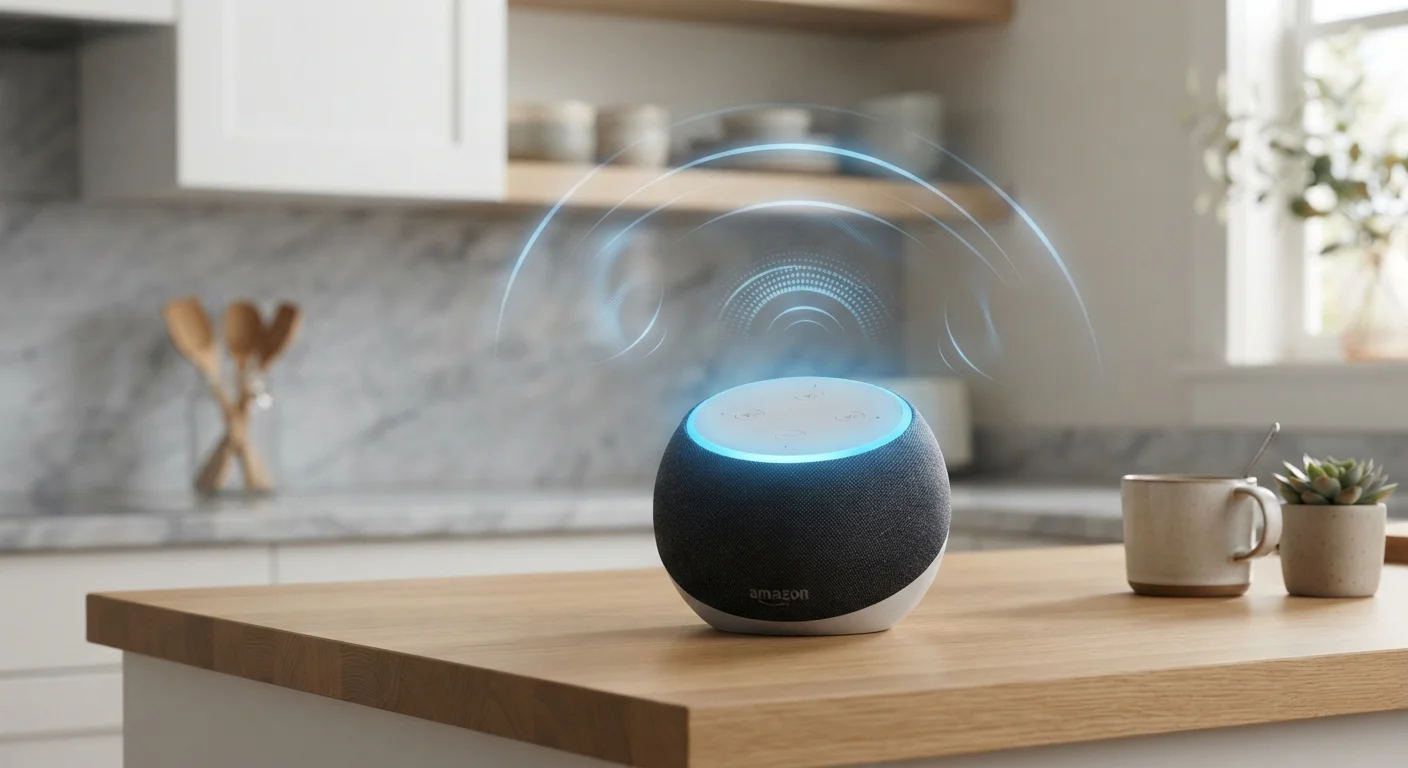
Step 1: Listening for the Wake Word
Your voice assistant isn't sending everything you say to the cloud — and understanding why starts with the wake word. Phrases like "Hey Google," "Alexa," or "Siri" are detected entirely on-device by a small, always-running model. This model is deliberately narrow: it's trained to recognize only that specific trigger phrase, ignoring everything else.
Once the wake word is detected, your device signals with a chime or light, then begins recording your actual command. That recorded audio — and only that audio — is packaged and sent to remote servers for the deeper processing steps.
Get Cleaner Results With These Habits
Pause for about half a second after saying the wake word before speaking your command. This gives the device time to open the recording window properly. Also, try phrasing requests as complete sentences — "Turn the living room lights to 50%" works better than a clipped "Lights, fifty."
Step 2: Converting Speech to Text (ASR)
The audio clip of your command is uploaded to the cloud, where Automatic Speech Recognition (ASR) converts it into written text. This step is far more complex than it sounds. ASR models must account for different accents, speaking speeds, background noise, and the natural way people blend words together in conversation.
Modern ASR systems are trained on enormous libraries of human speech, allowing them to make statistically informed guesses about what words were most likely spoken. They don't just hear sounds — they predict language patterns.
~1–3 sec
Typical end-to-end response time
Most consumer voice assistants complete the full ASR-NLU-TTS pipeline and deliver a spoken response within one to three seconds under normal network conditions.
95%+
Word-level accuracy for leading ASR systems
Research published by major AI labs has shown that top automatic speech recognition systems can achieve word error rates below 5% in clean audio conditions.
Step 3: Understanding What You Actually Meant (NLU)
Text alone isn't enough. Once your words are transcribed, a second AI layer called Natural Language Understanding (NLU) determines your intent — what you actually want the assistant to do. This is where the "intelligence" of the interaction lives.
NLU breaks your sentence into components: the action you want ("set a timer"), the subject ("pasta"), and any modifiers ("for 12 minutes"). It also handles context, so if you say "make it 15 minutes instead," the system understands you're adjusting the same timer, not creating a new one.
“The hardest part of building a voice assistant isn't recognizing words — it's figuring out what a person actually means, given all the ambiguity natural language carries.”
— A senior researcher in conversational AI, Natural Language Processing researcher, published in industry literature on human-computer interaction
Step 4: Generating and Delivering the Response
Once intent is identified, the assistant queries the appropriate service — a database, a connected app, or a search engine — and constructs a response. That response is then converted from text back into speech using Text-to-Speech (TTS) synthesis, which is why modern assistants sound increasingly natural rather than robotic.
The audio is streamed back to your device and played within seconds. For smart home commands, the assistant may also send a separate instruction signal to a connected device — like a light bulb or thermostat — at the same time.
Understanding this pipeline helps you work with your assistant more effectively. Speaking in full, clear sentences, pausing briefly after the wake word, and minimizing background noise all give the ASR and NLU layers better data to work with — which means fewer frustrating misunderstandings.
Your Voice Data and Privacy
Most voice platforms store audio clips of your requests to improve their models, though you can typically review and delete these clips in the app's privacy settings. Some platforms let you opt out of human review of recordings entirely. Checking these settings periodically is a straightforward way to stay in control of what data is retained.