
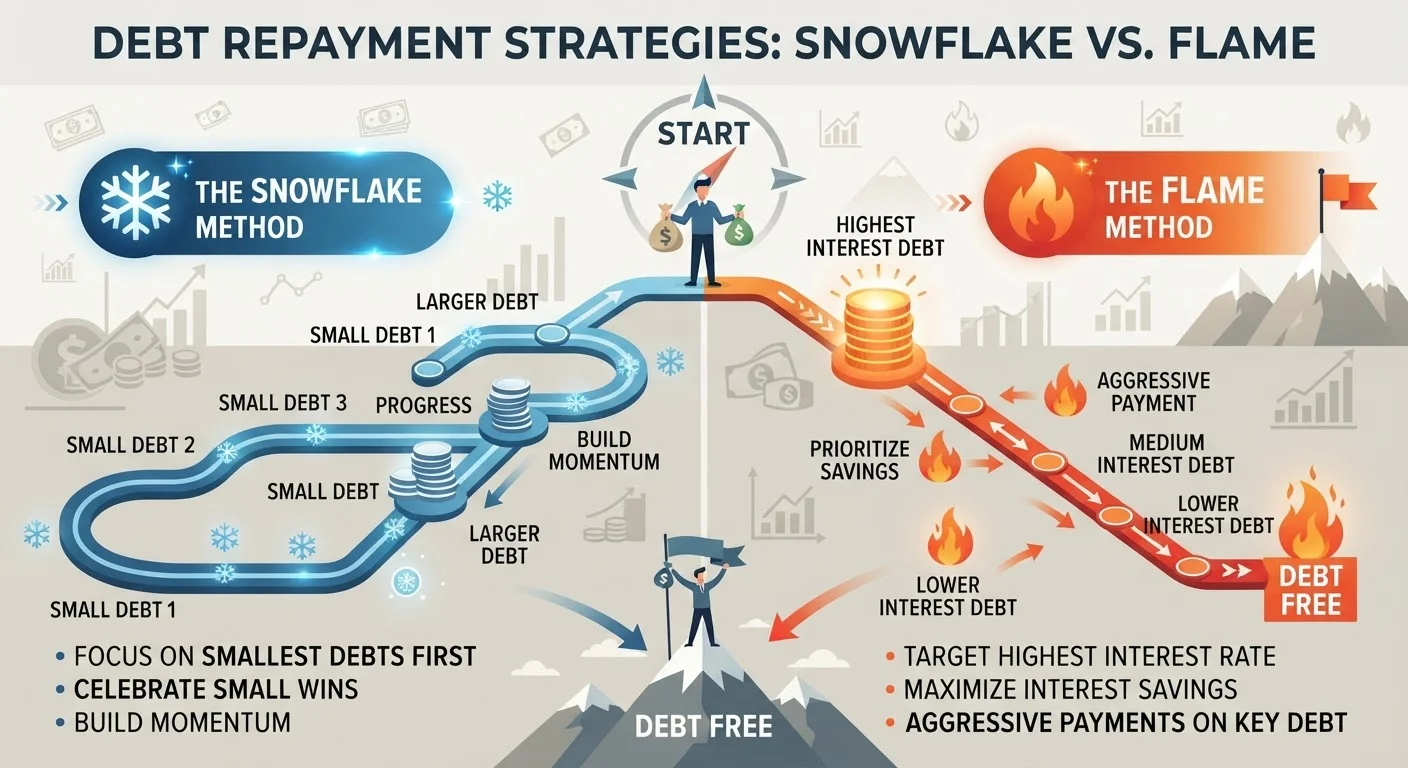
How Each Method Actually Works
Both the debt avalanche and debt snowball share the same basic mechanics: you pay the minimum on every debt each month, then throw any extra money at one specific target debt. The only difference is how you choose that target.
Debt Avalanche: You rank your debts by interest rate, highest to lowest. Your extra payment goes toward the highest-rate balance first. Once that's paid off, you redirect its payment to the next-highest-rate debt, and so on. The "avalanche" metaphor reflects the idea that you're cutting off interest at the source.
Debt Snowball: You rank your debts by balance, smallest to largest-regardless of interest rate. Your extra payment attacks the smallest balance first. Once that's gone, you roll its payment into the next-smallest, building a larger "snowball" of money as you go.
Neither method asks you to pay more overall each month-they just direct your payments differently. If you want a full picture of how these fit into a broader financial plan, see the complete framework for balancing savings and debt.
| Criterion | Debt Avalanche | Debt Snowball |
|---|---|---|
| Priority order | Highest interest rate first | Smallest balance first |
| Total interest paid | Lower (mathematically optimal) | Potentially higher |
| Time to first payoff | Longer if high-rate debt is large | Faster-smallest balance first |
| Psychological reward | Delayed; driven by savings | Frequent early wins |
| Best motivator | Long-term financial discipline | Visible progress and momentum |
| Complexity | Low-sort by APR | Low-sort by balance |
| Suits which debt profile | Debts with very different rates | Many small balances spread across accounts |
The Math: What the Numbers Say
On pure arithmetic, the debt avalanche wins. By eliminating high-interest debt first, you reduce the amount of interest accruing on your overall balance as quickly as possible. Depending on your interest rate spread and balances, this can mean hundreds or even thousands of dollars saved compared to the snowball approach.
The snowball, by contrast, may leave higher-rate balances growing longer while you knock out smaller ones. That's a real cost-though how significant it is depends on how different your rates actually are.
~$1,000+
Potential interest savings with avalanche vs. snowball
The exact amount varies widely by balance size and interest rate spread; higher-rate debt held longer produces the greatest difference between methods.
80%
Of Americans carry some form of household debt
According to Federal Reserve consumer credit data, a large majority of U.S. households are managing at least one form of debt at any given time.
That said, math alone doesn't determine outcomes. A plan you abandon halfway through costs far more than the "suboptimal" plan you complete. That's not a platitude-it's a practical reality. If you've run into this before, understanding why debt payoff plans stall can help you address it directly.
The Psychology: Why Behavior Often Decides the Winner
Research in behavioral economics consistently finds that people are more motivated by visible, near-term progress than by distant, abstract gains. The debt snowball is built around this reality. Paying off a $400 store card in two months feels like a win-and that feeling can fuel continued effort on the harder debts ahead.
This isn't a flaw in the snowball; it's a feature deliberately baked in. Some financial researchers and practitioners argue the snowball's higher completion rate makes it the more effective strategy in practice, even if it's not optimal in theory.
The avalanche, meanwhile, can feel slow if your highest-rate debt also carries a large balance. Months may pass before you close out your first account, and that can wear on motivation. If discipline isn't a concern for you, this is manageable-but it's worth being honest with yourself before choosing.
When Your Rates Are Close Together
If most of your debts carry similar interest rates-say, all between 18% and 22%-the mathematical gap between avalanche and snowball narrows considerably. In that case, the psychological benefits of the snowball may outweigh the modest cost difference. It's worth running the numbers for your specific debts before assuming one method is dramatically cheaper.
Not sure which camp you fall into? A personal debt checkup can help you map your debts clearly and identify which method fits your situation. And if you're newer to all of this, your first steps toward getting out of debt is a solid place to start.
Making the Choice-and Making It Work
Here's the practical test: look at your list of debts. If your highest-interest debt is also one of your smaller balances, the avalanche and snowball effectively converge-start there and capture both benefits. If your highest-rate debt carries a massive balance and won't be gone for years, think carefully about whether you'll stay motivated without a win along the way.
Some people split the difference: they use the snowball to clear one or two small accounts quickly, then switch to avalanche logic for the remaining larger balances. That's not a textbook method, but it's a legitimate adaptation if it keeps you moving.
Whichever method you choose, the fundamentals remain the same: stop adding new debt where possible, keep all minimum payments current, and direct every available extra dollar toward your target. If you're also trying to save while doing this, paying off debt while saving at the same time walks through how to split limited income without losing ground on either goal.
This article is for general informational purposes only and does not constitute personalized financial advice. Consider speaking with a qualified financial professional about your specific situation.