
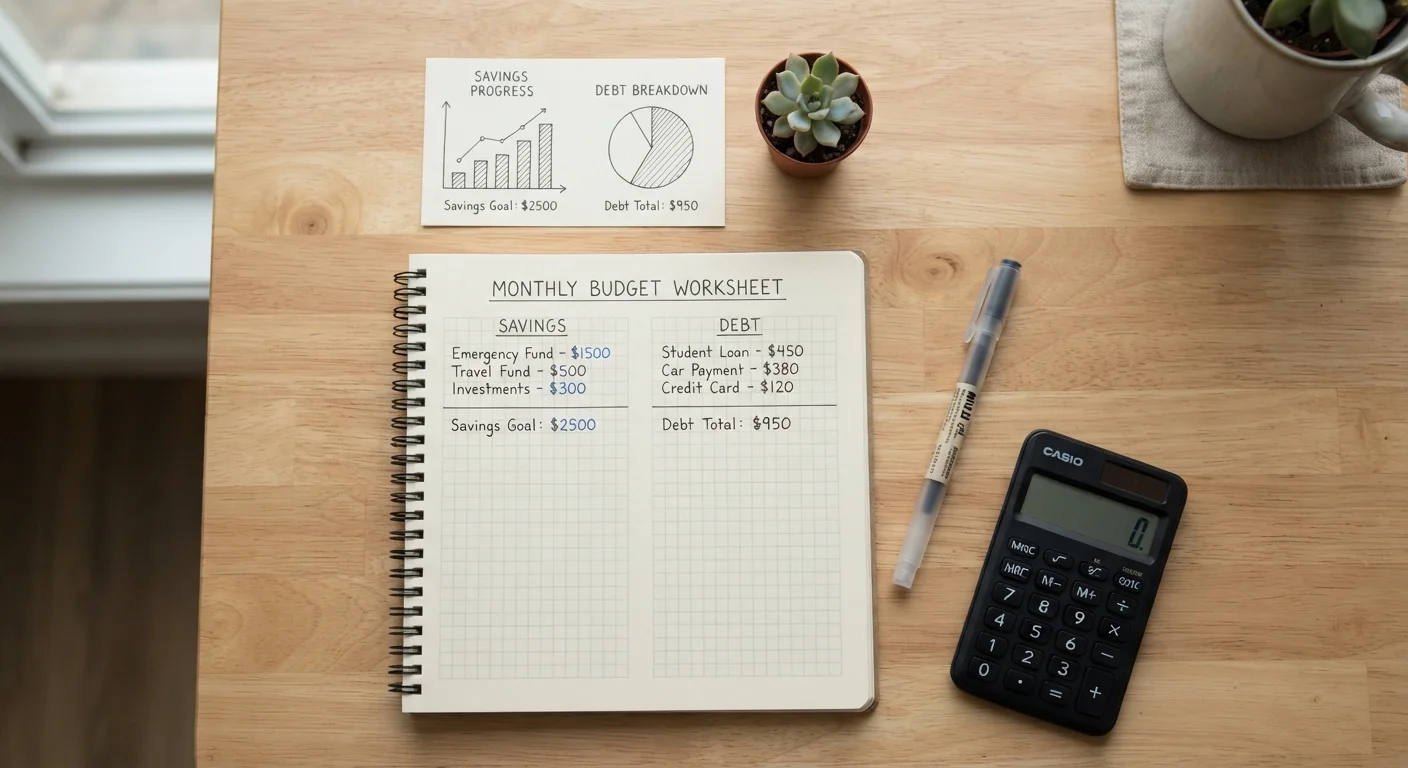
Why You Can't Ignore Either Side
Most personal finance advice treats saving and paying off debt as an either/or choice. In practice, ignoring either side creates real problems. Neglect savings entirely and a single car repair can force you back onto a credit card. Focus only on savings while carrying high-interest debt and you're likely losing money on net-most debt costs more in interest than a savings account earns.
The goal isn't to pick a winner. It's to build a framework that moves both goals forward, in the right order, given your specific situation. Think of your personal finances as a balance sheet: assets on one side, liabilities on the other. A healthy balance sheet grows both sides over time. For a solid foundation, see our complete guide to building a personal budget before diving into the strategies below.
Step One: Know Your Numbers
You can't allocate dollars effectively without a clear picture of where you stand. Before setting any priorities, gather the following:
- All debt balances, their interest rates (APR), and minimum monthly payments
- Current savings balances across checking, savings, and retirement accounts
- Monthly take-home income after taxes and any automatic deductions
- Fixed and variable monthly expenses, including minimums on all debts
The number that matters most is your discretionary cash flow-what's left after covering essential expenses and debt minimums. That's the pool you're allocating between extra debt payoff and savings contributions. Even a modest amount, consistently directed, compounds meaningfully over time.
22.8%
Average credit card interest rate
According to Federal Reserve data, average credit card rates have risen sharply in recent years, far exceeding typical savings yields.
56%
Americans who couldn't cover a $1,000 emergency from savings
A Bankrate survey found that more than half of U.S. adults lack sufficient liquid savings to cover a common unexpected expense.
4-5%
Typical high-yield savings account APY
High-yield savings rates have risen with broader interest rate movements, though they remain below most consumer debt costs.
The Priority Hierarchy: Which Comes First?
Once you know your numbers, apply this sequencing. It's not rigid-life rarely is-but it reflects the order that produces the best financial outcome for most people:
- Build a starter emergency fund ($1,000-$2,000). This buffer prevents a minor emergency from becoming new debt while you're paying off existing balances.
- Capture your full employer 401(k) match. A 50% or 100% match on your contributions is an immediate, guaranteed return no debt payoff strategy can beat.
- Pay off high-interest debt aggressively. Any debt carrying an interest rate above roughly 6-7% is almost certainly costing you more than any safe savings vehicle will earn. Credit card debt at 20%+ should be treated as a financial emergency.
- Expand your emergency fund to 3-6 months of expenses. Once high-interest debt is cleared, redirect that payment toward building a full cushion.
- Pursue longer-term savings and lower-rate debt simultaneously. Student loans, auto loans, and mortgages in the 3-6% range can coexist with retirement contributions and other savings goals.
When you pay off a debt, immediately redirect that exact minimum payment amount to your next financial goal-don't let it disappear into spending.
This 'payment stacking' technique accelerates progress on both debt and savings without requiring a lifestyle change, since the money was already allocated.
Before paying extra on any debt, confirm there's no prepayment penalty-some installment loans include fees that can offset the interest savings.
Prepayment clauses are common on older auto loans and some personal loans; a quick check of your loan agreement takes minutes and can prevent a costly surprise.
If your debt payoff momentum ever stalls, our article on why debt payoff plans lose steam covers exactly what to do next.
This article provides general financial education and is not personalized financial advice. Consult a licensed financial professional for guidance specific to your situation.
Splitting Your Dollars: Practical Allocation Methods
Once you've addressed the hierarchy above, you'll likely reach a stage where splitting discretionary dollars between savings and moderate-rate debt repayment makes sense. Two common approaches:
The Percentage Split
Allocate a fixed percentage of your discretionary cash flow to each goal. A common starting point is 70% toward debt and 30% toward savings, adjusted based on your debt interest rates and savings urgency. Higher rates push the split toward debt; lower rates allow more balance.
The Parallel Track
Set minimum savings targets (such as a fixed monthly amount into an emergency or retirement account) and direct everything remaining toward debt. This keeps both goals actively funded without constant recalculation.
Neither method is universally superior-what matters is that you pick one, automate it, and revisit it quarterly. The Budgeting Basics hub has additional tools for tracking how your allocations perform month to month.
Staying on Track and Adjusting Over Time
A framework only works if you maintain it. Build in a quarterly review-30 minutes to check balances, recalculate discretionary cash flow, and confirm your split still makes sense. Common triggers that should prompt an immediate review include:
- A raise, bonus, or change in income
- Paying off a debt and freeing up its minimum payment
- A large unexpected expense that drew down savings
- A change in interest rates on variable-rate debt
As debts disappear, redirect their minimum payments-that's extra cash flow you've effectively unlocked. Many people find that their savings rate accelerates significantly in the final stretch of debt repayment, because those freed-up dollars stack quickly.
For day-to-day habits that reinforce long-term progress, the Everyday Money Tips hub offers practical, low-effort strategies worth bookmarking. Consistent small actions-automated transfers, spending check-ins, rate monitoring-matter more than any single large decision.