
Why These Myths Are So Costly
Misinformation about saving and debt isn't just annoying — it actively keeps people from making financial progress. When someone believes they must eliminate all debt before opening a savings account, they may spend years without any financial cushion. When someone thinks carrying a credit card balance builds credit, they pay unnecessary interest for a benefit that doesn't exist.
These aren't fringe beliefs. They circulate widely, sometimes even from well-meaning family members or outdated advice columns. The good news is that the corrections are straightforward. Understanding what's actually true — backed by how credit systems and compound interest actually work — makes it much easier to take productive action.
For a broader look at how financial misconceptions can stall progress, see common money myths that keep people from saving. And if budgeting feels just as confusing, budgeting myths that keep people from starting covers similar ground.
Myth
You need to be completely debt-free before you start saving money.
Fact
Building even a small emergency fund while carrying debt reduces financial risk and prevents you from taking on new debt when unexpected costs hit.
This myth sounds logical — pay off what you owe before putting money aside — but it ignores what happens when an unplanned expense arrives. Without any savings buffer, a car repair or medical bill typically goes straight onto a credit card, creating more debt. Most financial educators recommend building a starter emergency fund of $500–$1,000 alongside debt repayment, then focusing more aggressively on high-interest balances. The two goals are not mutually exclusive.
Myth
Carrying a balance on your credit card each month helps build your credit score.
Fact
Paying your balance in full each month does not hurt your credit — it avoids interest charges while still demonstrating responsible use.
This misconception has real financial consequences. Credit scoring models — including the widely referenced FICO score — do not reward cardholders for carrying a balance. What actually matters is your credit utilization ratio (how much of your available credit you're using) and your payment history. Keeping balances low and paying on time is the formula that supports a strong score. Carrying a balance only means paying interest, which benefits the card issuer — not you. For a deeper look at why even minimum payments can be costly, see why minimum payments cost more than you think.
Myth
Saving small amounts isn't worth it — you need significant income before it makes a difference.
Fact
Regular small contributions to savings grow meaningfully over time through compound interest, and the habit of saving is itself valuable regardless of the amount.
The mathematical reality of compounding means that consistent, modest contributions made early outperform larger contributions made later. Setting aside even $25–$50 per month into a savings account builds a habit and accumulates faster than intuition suggests, particularly over years. The barrier isn't the amount — it's starting. Waiting for a raise or windfall to begin saving typically just delays the starting point, at a real cost over time.
Myth
All debt is equally bad and should be paid off as fast as possible, no matter what.
Fact
Debt varies significantly by interest rate and type. High-interest consumer debt warrants urgency, but low-interest debt may be manageable alongside other financial goals.
Treating a 24% APR credit card balance the same as a 4% student loan or mortgage leads to misallocated resources. The general principle most financial educators recommend is to prioritize debt by interest rate: aggressively pay down high-interest balances while making regular payments on lower-rate debt. Money freed from high-interest debt repayment can then be redirected toward savings or other goals. Context matters — blanket urgency about all debt can actually slow overall financial progress. See everyday money tips for more on prioritizing financial decisions.
Myth
Closing old credit card accounts you no longer use will improve your credit score.
Fact
Closing old accounts often reduces your available credit, which can increase your utilization ratio and lower your score.
Credit history length and total available credit both factor into scoring models. When you close an older account, you lose that card's credit limit from your total available credit. If you carry any balances on other cards, your utilization ratio — the percentage of available credit in use — immediately rises. A higher utilization ratio typically lowers your score. In most cases, leaving unused accounts open (as long as there's no annual fee creating a real cost) is the better approach for your credit profile.
What the Evidence Actually Supports
The data on compound interest and credit scoring consistently undermines the myths above. Delaying savings by even a few years has a measurable long-term cost, since growth builds on itself over time. Likewise, credit bureaus do not reward cardholders for paying interest — they reward responsible use, which means keeping balances low relative to credit limits and paying on time.
~30%
Weight of credit utilization in FICO scoring
According to FICO's published scoring breakdown, amounts owed — including utilization ratio — account for approximately 30% of a standard FICO credit score.
35%
Weight of payment history in FICO scoring
Payment history is the single largest factor in FICO scores, underscoring why on-time payments matter far more than whether you carry a balance.
$400
Median emergency savings threshold cited in Fed surveys
Federal Reserve surveys on household finances have found that a significant share of U.S. adults would struggle to cover an unexpected $400 expense without borrowing or selling something.
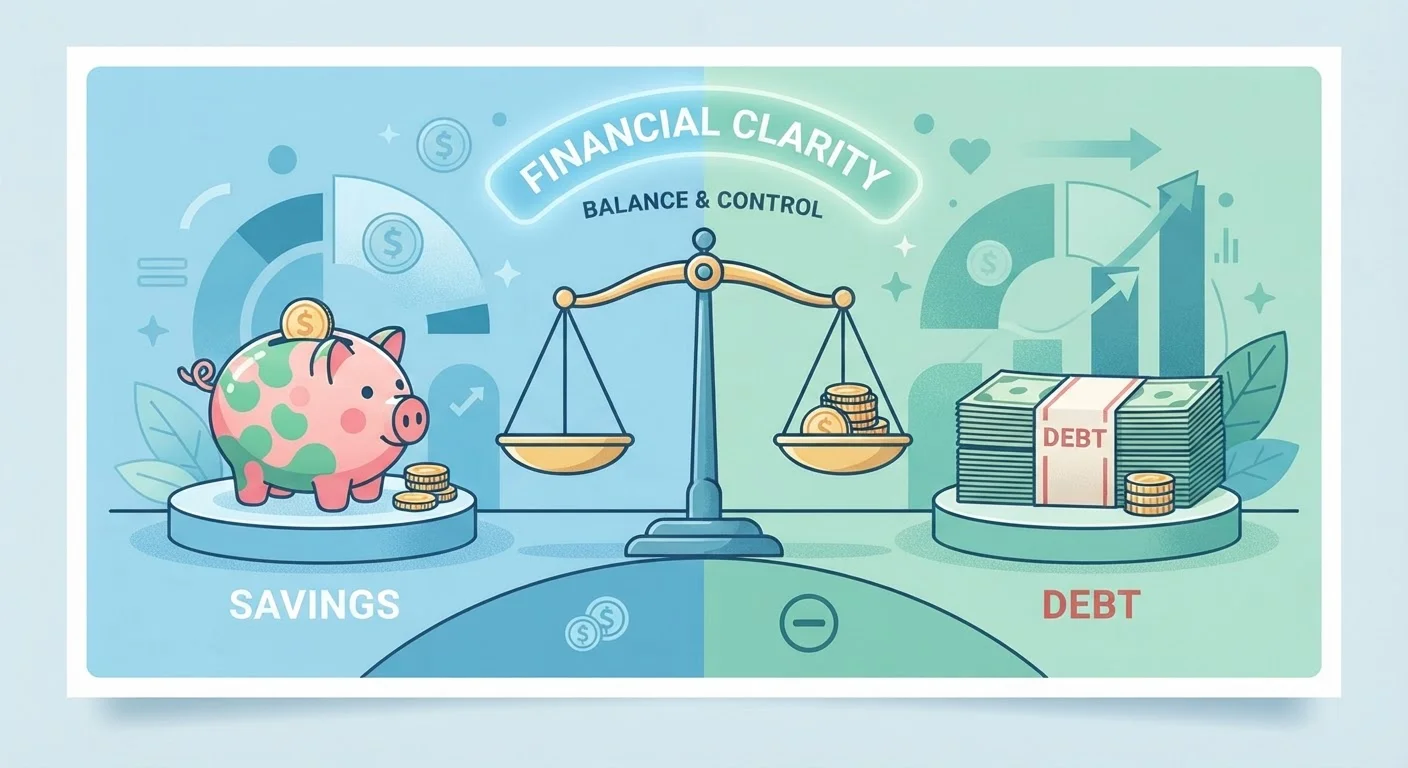
The most effective approach for most people is a parallel strategy: allocate money toward both debt repayment and savings at the same time, prioritizing by interest rate. High-interest debt deserves aggressive repayment, while a modest emergency fund provides a buffer that prevents new debt when unexpected expenses arise.
For a structured way to think through this, paying off debt while saving at the same time offers a practical split strategy. If you want a full framework, balancing savings goals and debt repayment walks through both sides of the equation end-to-end.
Don't Skip the Emergency Fund Entirely
Putting every spare dollar toward debt repayment while keeping zero savings leaves you one unexpected expense away from adding new high-interest debt. Even a modest emergency fund acts as a financial firewall. Most financial educators suggest building at least a small cash cushion — commonly cited around $500 to $1,000 — before aggressively accelerating debt payments beyond the minimums.
This article is for general informational and educational purposes only and does not constitute personalized financial advice. For guidance specific to your situation, consult a qualified financial professional.