
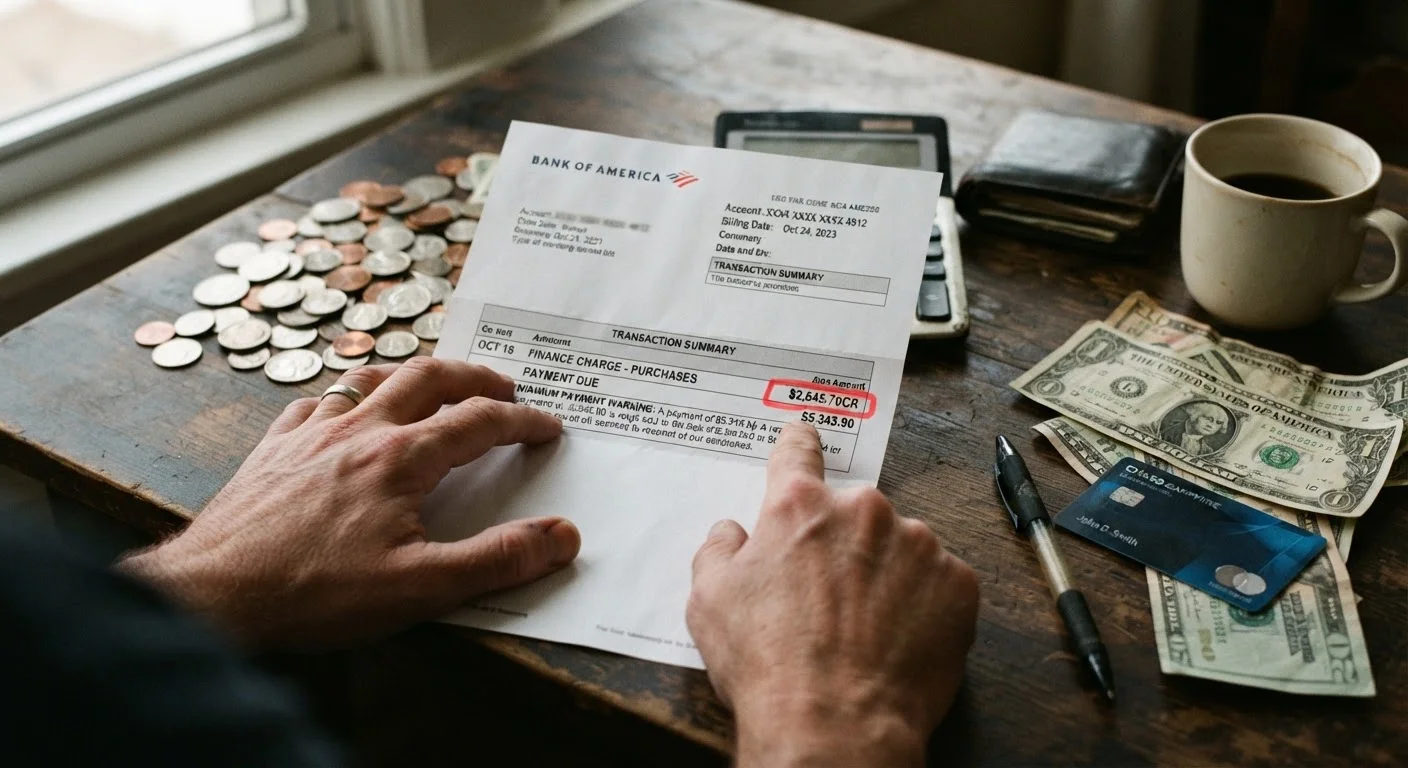
How Compounding Works Against You
Interest on most credit cards doesn't accumulate once a year - it compounds daily. Your lender divides your APR by 365 to get a daily rate, then applies that rate to your current balance every single day. If you carry a balance month to month, you're paying interest on your interest.
Here's what that looks like in practice: a $3,000 balance at a 24% APR accrues roughly $1.97 in interest on day one. That amount gets added to your balance, and the next day's interest is calculated on $3,001.97 - and so on. It sounds small, but over months and years, the effect is substantial. This is the core reason high-interest debt can feel impossible to outrun.
~20%+
Average credit card APR in the U.S.
The Consumer Financial Protection Bureau has reported average credit card interest rates consistently above 20% in recent years, with many cards charging significantly higher rates.
10+ years
Time to pay off balance with minimums only
On a typical $3,000 balance at a high APR, paying only the minimum can extend repayment well beyond a decade and multiply the total interest paid.
~30%
Credit score weight from utilization
Credit utilization - your balance relative to your credit limit - accounts for roughly 30% of standard credit score calculations, according to widely cited scoring models.
Understanding this dynamic is the starting point for any realistic repayment plan. See your first steps toward getting out of debt for a beginner-friendly breakdown of what to do once the math clicks.
Why Minimum Payments Keep You Stuck
Credit card issuers typically set minimum payments at around 1-3% of your outstanding balance, or a small fixed dollar amount - whichever is greater. On a $3,000 balance, that might mean a minimum payment of $60-$90 per month.
The problem: at a 24% APR, that same $3,000 balance is generating roughly $60 in interest per month. If your minimum payment is $75, only $15 of it is actually shrinking your balance. At that pace, paying off the debt could take a decade or more - and cost you thousands in interest charges along the way.
Pay More Than the Minimum When Possible
Even an extra $25-$50 above the minimum payment each month can meaningfully cut both repayment time and total interest paid. If your budget is tight, look for one recurring expense to temporarily redirect. Small increases in payment amount have a disproportionate impact when interest is compounding daily.
This isn't a bug in the system - it's how the math is structured. Minimum payments on credit cards cost far more than most people realize, and seeing those numbers laid out often changes how borrowers prioritize repayment.
The Real Cost of Carrying a Balance
High-interest debt has a compounding opportunity cost that goes beyond the interest itself. Every dollar spent on interest is a dollar that can't go toward savings, emergencies, or other goals. If you're earning 4-5% on a high-yield savings account while carrying a 25% APR credit card balance, the math is working strongly against you.
This is why many financial educators suggest treating high-interest debt repayment as the financial equivalent of a guaranteed return - paying off a 24% debt is roughly equivalent to earning 24% on an investment, risk-free. No savings product or investment can reliably match that.
If you're trying to figure out how to balance debt repayment with other goals, paying off debt while saving at the same time offers practical ways to split limited income without sacrificing progress on either front.
This article is for general informational and educational purposes only and does not constitute personalized financial advice. Consult a qualified financial professional for guidance specific to your situation.