
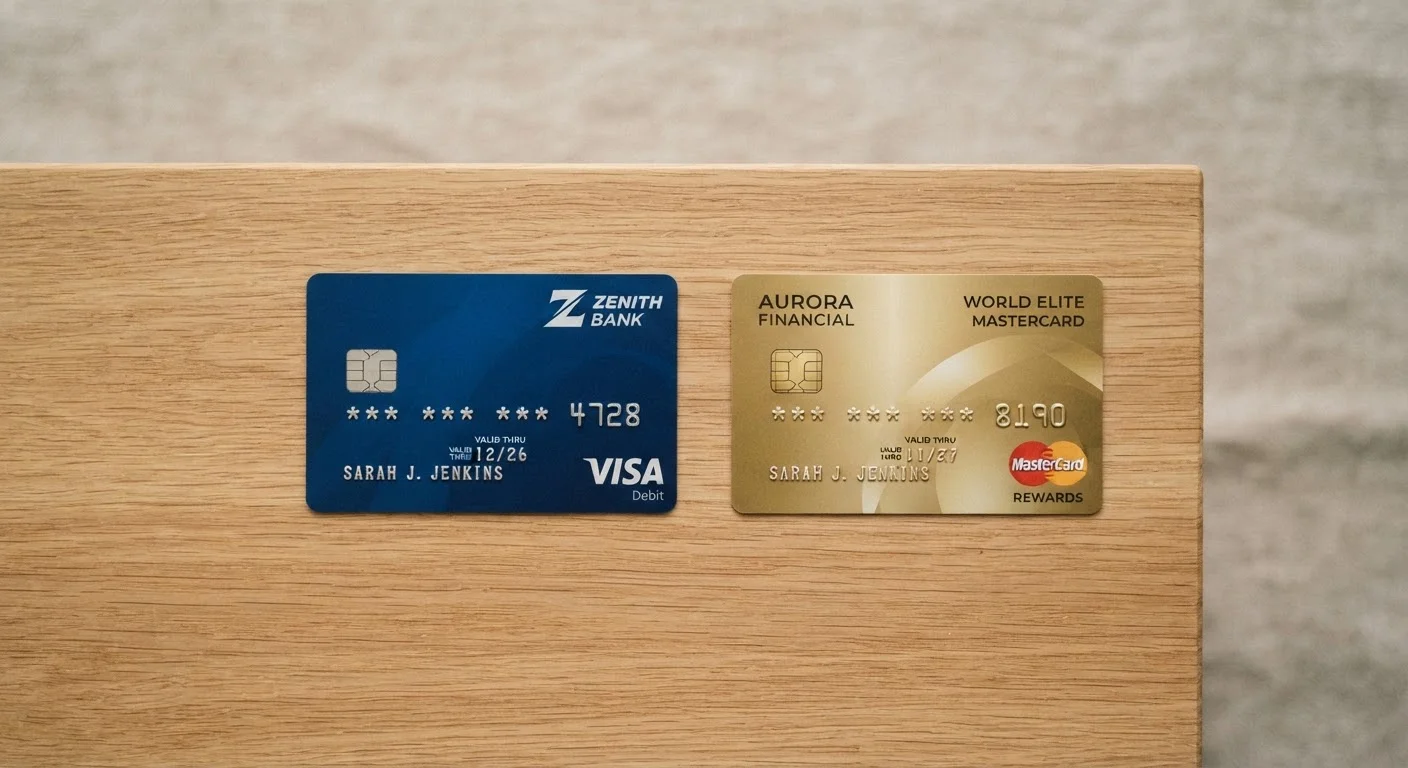
How Each Card Actually Works
The mechanics are simple but consequential. A debit card is linked directly to your checking account. When you swipe or tap, the money leaves your account almost immediately. There is no bill to pay later and no interest - because you're spending funds you already own.
A credit card works differently. The card issuer advances you money for each purchase, and you repay that amount - ideally in full - when your monthly statement is due. If you carry a balance past the due date, the issuer charges interest based on the card's APR. Understanding terms like APR is worth your time; our guide to common financial terms covers these clearly.
This core mechanical difference drives nearly every practical distinction between the two cards.
| Criterion | Debit Card | Credit Card |
|---|---|---|
| Funds source | Your checking account | Issuer's credit line |
| Interest charges | None | Yes, if balance carried past due date |
| Fraud liability (federal floor) | Up to $500 if reported late | Capped at $50 federally |
| Impact on credit score | None | Yes - positive or negative |
| Overspending risk | Low (limited to balance) | Higher without discipline |
| Rewards potential | Rare or minimal | Common; cash back, points, miles |
| Dispute resolution | Cash already withdrawn | Charge on statement, cash intact |
Fraud Protection: A Meaningful Gap
This is where the two cards diverge most sharply. Under the Electronic Fund Transfer Act, your liability for unauthorized debit card charges depends heavily on how quickly you report them. Report a lost or stolen card within two business days and your liability is capped at $50. Wait longer and that cap climbs to $500 - or disappears entirely if you wait more than 60 days after your statement is issued.
More importantly, when fraud hits a debit card, real money is already gone from your account. Getting it back requires a bank investigation that can take days or weeks, during which bills may go unpaid.
Credit cards offer stronger baseline protection under the Fair Credit Billing Act. Your maximum liability for unauthorized charges is $50, and most major issuers carry a $0 liability policy. Critically, the disputed charge sits on a statement - not your bank account - so your actual cash remains untouched while the dispute is resolved.
$500
Max debit fraud liability after 2 days
Under the Electronic Fund Transfer Act, waiting more than two business days to report unauthorized debit card use raises your personal liability cap significantly.
$50
Federal credit card fraud liability cap
The Fair Credit Billing Act limits consumer liability for unauthorized credit card charges to $50, and many issuers voluntarily offer $0 liability policies.
35%
Credit score weight: payment history
According to FICO's publicly published scoring model, payment history is the single largest factor in a consumer's credit score - debit cards do not influence this at all.
Spending Control, Credit Building, and Rewards
Spending discipline: Debit cards impose a natural ceiling - your account balance. That constraint is genuinely useful for anyone prone to overspending. Credit cards remove that ceiling, which is a benefit for disciplined users and a real risk for those who aren't. If you're managing a budget carefully, tools described in our cash envelope vs. digital tracking comparison can help either card fit a structured spending plan. You can also pair either card with everyday money tracking apps to monitor your habits in real time.
Credit history: Debit card use is not reported to credit bureaus. Credit card use is - and your payment history, credit utilization ratio, and account age all factor into your credit score. For consumers building or rebuilding credit, responsible card use matters.
Rewards: Many credit cards offer cash back, points, or travel miles. These can be genuinely valuable - but only if you're not carrying a balance. Interest charges accumulate fast, and our article on why minimum payments cost more than you think illustrates how quickly interest erodes any reward benefit. Debit cards rarely offer comparable rewards programs.
When You're Paying Down Debt
If you're currently carrying credit card debt, adding everyday charges to the same card can slow your progress and increase total interest paid. Consider using a debit card for daily spending while you focus on repayment. Our guide to paying off debt while saving covers practical ways to manage both goals at once.
This article is for general informational purposes only and is not personalized financial advice. Consult a qualified financial professional for guidance specific to your situation.