
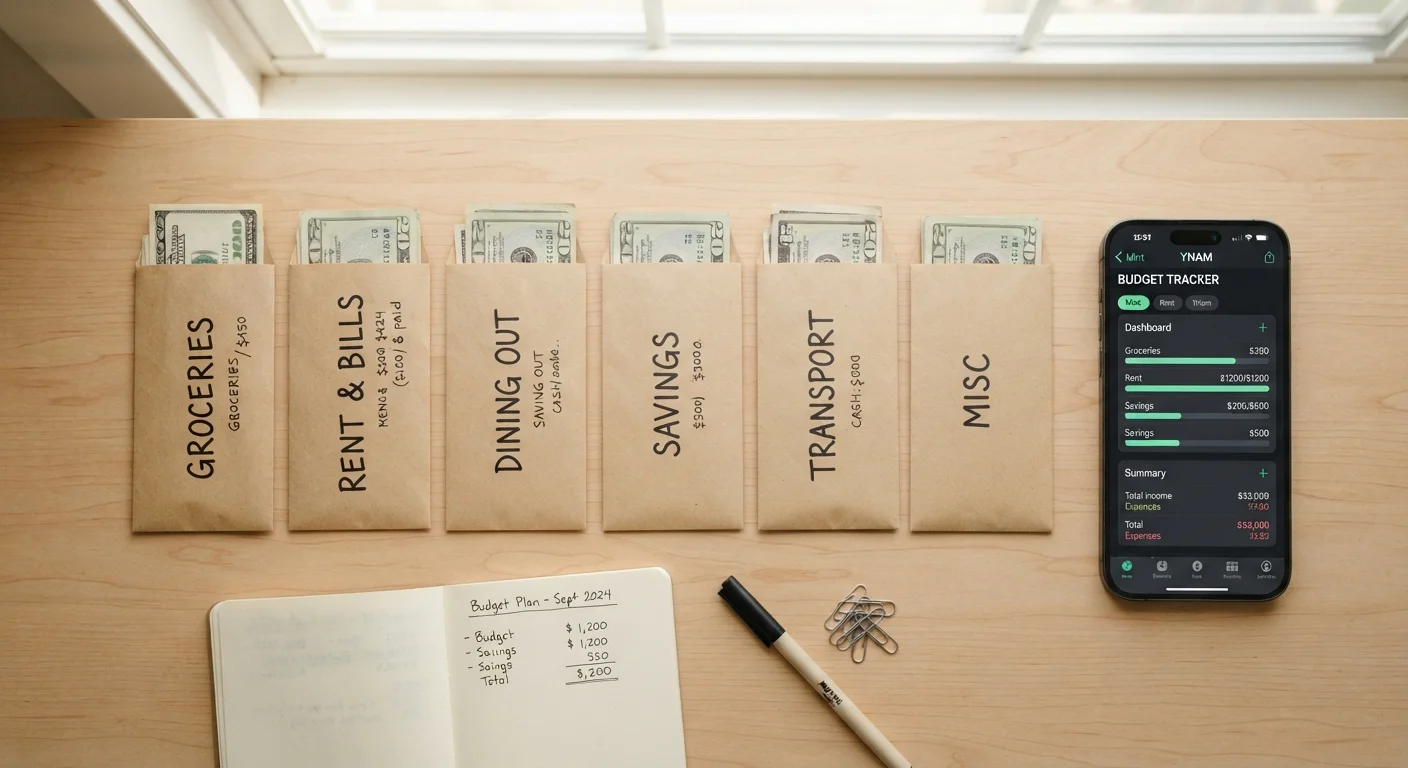
How the System Actually Works
The original version is straightforward: on payday, you withdraw cash and physically divide it into labeled envelopes - one for groceries, one for gas, one for dining out, and so on. Throughout the month, you spend from the relevant envelope. No borrowing between categories without a conscious decision. When the cash is gone, it's gone.
That physical friction is intentional. Handing over bills feels more real than tapping a card, which is why research in behavioral economics consistently finds that cash payments lead to more careful spending decisions. The envelope system turns that psychological effect into a structural habit.
Fixed expenses like rent, utilities, and loan payments don't typically get envelopes - those are automatic. The system targets discretionary spending: the categories where most people lose track of how much they've spent.
Start with Your Three Biggest Flexible Categories
Rather than creating an envelope for every expense line, identify the three categories where you most frequently overspend. Groceries, dining, and entertainment are the most common culprits for American households. Gaining control there first builds confidence before expanding the system.
Why People Still Use It in a Card-Based World
Most Americans rarely carry cash, which raises an obvious question: is envelope budgeting still practical? The answer is yes - because the insight behind it has nothing to do with paper money.
The real mechanism is pre-commitment. You decide, before the month starts, exactly how much you'll spend in each category. That decision is made when you're calm and deliberate - not at the moment of purchase, when impulse and convenience take over.
33%
Americans with no formal monthly budget
A Gallup survey found roughly one-third of U.S. adults do not track their spending against a planned budget in any consistent way.
~$1,500
Average monthly discretionary spending per U.S. consumer unit
Bureau of Labor Statistics Consumer Expenditure data shows a substantial share of household spending falls in categories where envelope-style limits could apply.
Apps that replicate envelope logic digitally capture most of this benefit. You assign a dollar limit to each category, track spending against it in real time, and get a clear signal when a category is nearly depleted. The absence of physical cash means you'll need to be more disciplined about checking balances before spending - but the structure is preserved.
For a side-by-side look at how this compares to pure expense tracking, see cash envelope budgeting vs. digital expense tracking.
Setting Up Your Own Envelope System
Start by listing your net monthly income - what actually lands in your bank account after taxes and deductions. Then identify every fixed expense that recurs at a set amount. What remains is your discretionary pool, and that's what gets divided into envelopes.
- Choose categories that match your actual spending habits, not an idealized version of them. If you consistently spend on coffee, give it an envelope rather than hiding it inside "dining."
- Set realistic limits. Review two to three months of past spending to find realistic baselines. Cutting a category to zero overnight rarely sticks.
- Decide on your medium. Physical envelopes work well for people who primarily use cash or want maximum tangibility. Separate checking accounts or sub-accounts offer a digital equivalent. Budget apps with category limits are the most convenient but require consistent manual logging or linked accounts.
- Establish a monthly reset ritual. Refill envelopes on the same day each month - or each pay period if paid biweekly. Consistency reinforces the habit.
If you've never built a budget before, building a first budget from scratch is a solid starting point before layering in the envelope structure.
“A budget is telling your money where to go instead of wondering where it went.”
— Dave Ramsey, Personal finance author and radio host, widely credited with popularizing the modern cash envelope system
Common Pitfalls and How to Avoid Them
The most frequent failure point is creating too many categories. Tracking fifteen envelopes becomes a part-time job, and most people abandon the system within a few weeks. Start with fewer, broader categories and subdivide only after the habit is established.
A second pitfall: treating the system as a punishment rather than a tool. If you consistently overspend the dining envelope, the right response isn't guilt - it's either adjusting the limit to something realistic or examining what's driving the behavior. The saving and debt resources hub covers strategies for redirecting spending toward financial goals once a budget is in place.
Finally, some expenses are genuinely irregular - annual subscriptions, car registration, holiday gifts. These don't fit neatly into a monthly envelope. The fix is a sinking fund: divide the annual cost by twelve and set aside that amount monthly in a dedicated envelope or account. When the bill arrives, the money is already there.
For a broader look at how envelope budgeting fits alongside other frameworks, see building a complete personal budget system.
This article is for general informational and educational purposes only and does not constitute personalized financial advice. Consult a qualified financial professional for guidance tailored to your specific circumstances.