
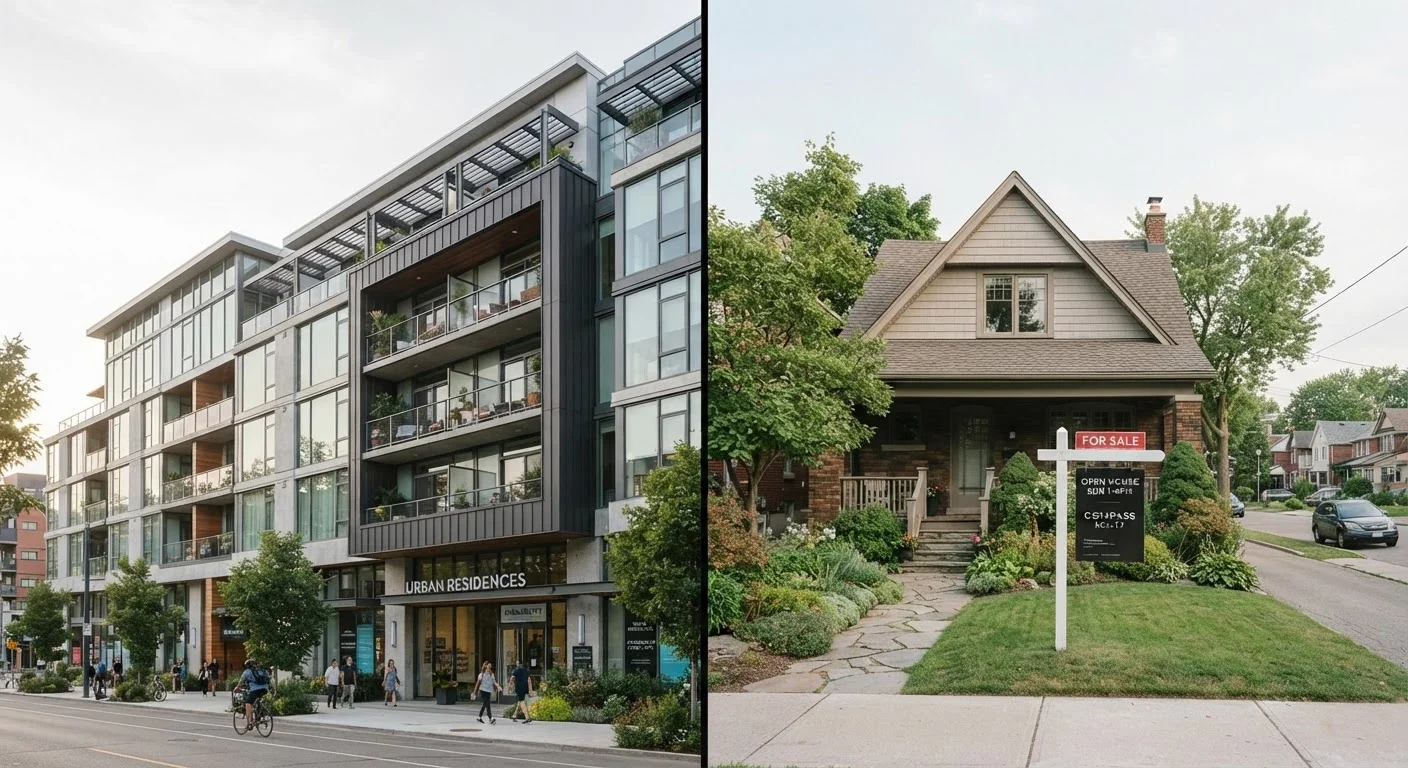
The Core Question: What Are You Actually Comparing?
The rent-vs-buy debate is often framed as a simple financial contest. In reality, it involves a web of financial, lifestyle, and timing variables that interact differently for every household. Before weighing the numbers, it helps to clarify what each path actually entails.
Renting means paying for the right to occupy a property without ownership. Your monthly payment covers housing, and your landlord retains responsibility for major structural repairs and property taxes. You gain flexibility but build no equity in the home itself.
Buying means acquiring a property — typically with a mortgage — and taking on ownership in full, including maintenance, taxes, insurance, and the financial risk that comes with any asset tied to local real estate markets.
For a broader look at how homeownership functions as a financial instrument, see Owning a Home as a Financial Asset: Possibilities and Real Limitations.
| Criterion | Renting | Buying |
|---|---|---|
| Upfront costs | Security deposit, first/last month's rent | Down payment, closing costs (2–5%) |
| Monthly cost predictability | Fixed for lease term; can rise on renewal | Mortgage fixed (if fixed-rate), but taxes/insurance/maintenance vary |
| Equity building | None in the property | Yes, gradually through mortgage paydown and appreciation |
| Flexibility to relocate | High — typically 30–60 days notice | Low — selling takes time and carries transaction costs |
| Maintenance responsibility | Landlord handles most major repairs | Owner bears all costs |
| Customization freedom | Limited by lease terms | Full control within local codes |
| Market risk exposure | None on property value | Direct exposure to local real estate market |
| Tax considerations | No property-related tax benefits | Potential mortgage interest and tax deductions (varies by situation) |
The Financial Reality of Each Option
Monthly cost comparisons between renting and buying can be misleading if they only include the mortgage payment. The true cost of homeownership typically includes property taxes, homeowner's insurance, private mortgage insurance (PMI) if your down payment is below 20%, HOA fees where applicable, and an ongoing maintenance budget — commonly estimated at 1–2% of the home's value annually, though actual costs vary widely.
Renting's costs are more predictable in the short term: your monthly rent plus renter's insurance. However, rent can increase at lease renewal, and you have no claim on the property's value if it appreciates.
~1–2%
Annual home maintenance cost as share of home value
A commonly cited rule of thumb among housing professionals, though actual costs depend heavily on the home's age, condition, and location.
6–10%
Typical total transaction cost to sell a home
Includes agent commissions, closing costs, and staging or repair expenses — a meaningful drag on short-term ownership returns.
5+ years
Common minimum horizon for buying to outperform renting
Many housing economists use a five-year rule of thumb, though the break-even point varies significantly based on local market conditions and financing.
Buying does offer the potential for equity growth, but that growth is not guaranteed and depends heavily on local market conditions, how long you stay, and how much you paid. Transaction costs — typically 2–5% of the purchase price to buy and 6–10% to sell — mean short ownership periods often result in net losses.
Understanding your mortgage structure matters here. See Fixed-Rate vs. Adjustable-Rate Mortgages: How Each One Works to understand how rate structure affects your long-term costs.
Flexibility, Stability, and Lifestyle Fit
Financial calculations aside, renting and buying serve different life stages and priorities. Renting offers meaningful advantages for households that value mobility — whether for career opportunities, personal circumstances, or simply uncertainty about where they want to live long-term. A lease, typically 12 months, carries far less commitment than a mortgage measured in decades.
Homeownership, by contrast, provides a form of housing stability that renting cannot fully replicate. You cannot be displaced by a landlord's decision to sell or not renew a lease. You have the freedom to renovate, paint, landscape, and personalize — within local codes — in ways most leases prohibit.
That stability does come with trade-offs. Homeowners bear the full burden of repair costs and cannot easily exit the asset without significant expense. For households navigating job uncertainty, health changes, or other flux, the illiquidity of ownership can become a genuine liability rather than an asset.
Renting Is Not 'Throwing Money Away'
One of the most persistent myths in housing is that renters waste money while buyers build wealth. In reality, renters receive a service — housing — in exchange for their payment, just as buyers do. The equity argument for buying is real but depends heavily on how long you stay, what the market does, and how costs are accounted for. Neither path is financially irrational when chosen with clear eyes and good information.
If you're early in the process of evaluating renting, Renting for the First Time: A Ground-Up Guide walks through the rental process from application to move-in.
How to Think Through Your Own Situation
Rather than asking which option is better in the abstract, consider the factors most predictive of whether buying makes sense for a specific household:
- Time horizon: The longer you plan to stay, the more buying tends to pencil out. Most housing economists suggest a minimum of five years as a rough threshold, though this varies by market.
- Local price-to-rent ratio: In high-cost metros, annual rents may represent only 2–3% of equivalent purchase prices, making renting comparatively efficient. In lower-cost markets, buying may become competitive much sooner.
- Financial readiness: Beyond a down payment, buyers need closing costs, an emergency reserve for repairs, and stable qualifying income. Down Payment Options: What Each Percentage Means for Your Loan explains how your initial contribution shapes loan terms and monthly costs.
- Opportunity cost: Money tied up in a down payment cannot simultaneously be invested elsewhere. This does not make buying wrong, but it is a real trade-off worth acknowledging.
It also helps to separate commonly repeated assumptions from actual mechanics. Home Buying Myths That Trip Up First-Time Purchasers addresses several widely held beliefs — including the 20% down payment assumption — that don't always hold up under scrutiny.
This article provides general educational information about housing decisions. It is not financial, legal, or investment advice. Readers should consult qualified professionals before making decisions specific to their own circumstances.