
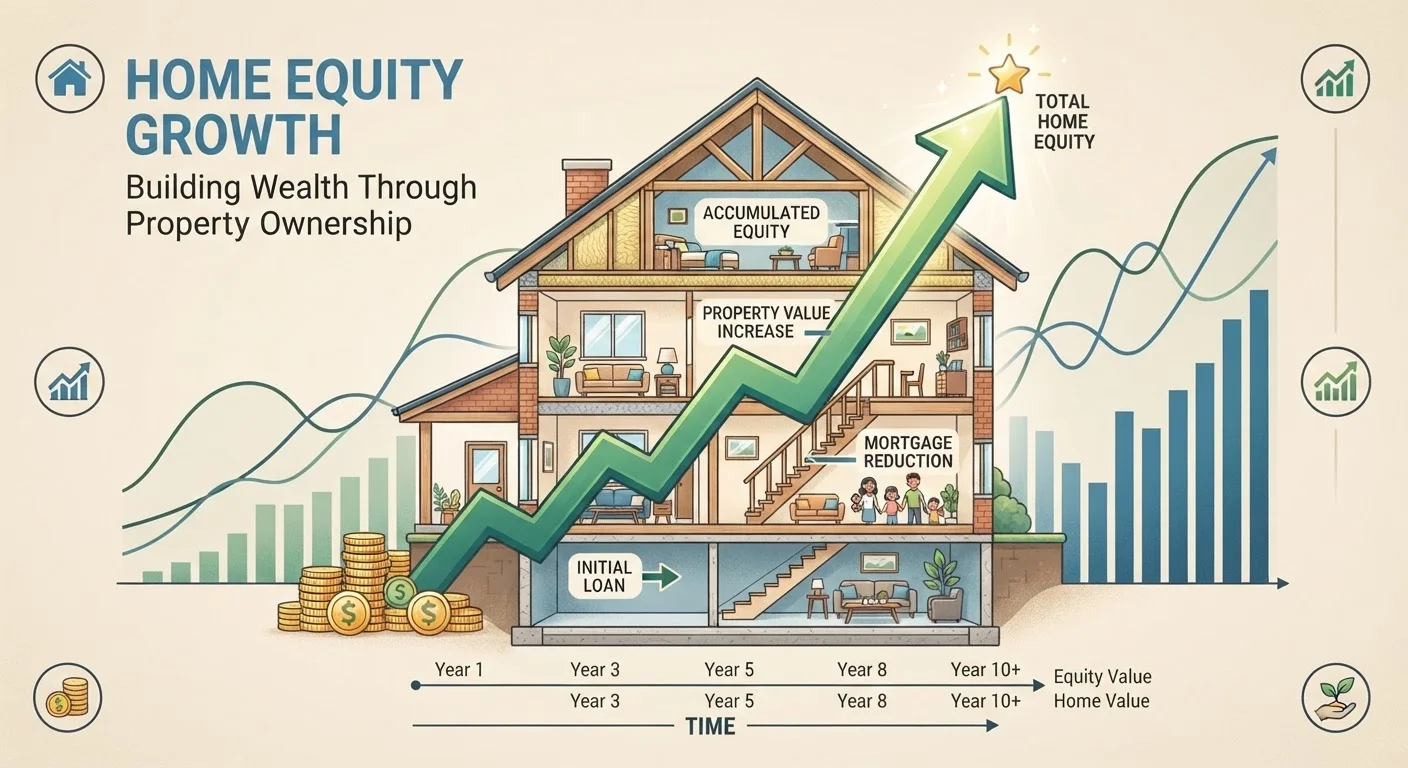
What Home Equity Actually Means
Home equity is the portion of your property that you own outright - in financial terms, the difference between what your home is currently worth and what you still owe on your mortgage.
Simple formula: Current market value − outstanding mortgage balance = home equity.
If your home appraises at $320,000 and your remaining loan balance is $200,000, you have $120,000 in equity. That figure is not cash in your bank account; it is value locked inside the asset. You cannot spend it directly without either selling the home or using a financial product that converts equity into a loan.
Home Equity
The portion of your home's value you own outright - calculated as the current market value minus the outstanding mortgage balance.
Principal
The original loan amount borrowed, separate from interest. Each mortgage payment reduces the principal balance, which increases equity.
Appreciation
An increase in your home's market value over time, driven by local demand, market conditions, and property characteristics.
HELOC
A home equity line of credit - a revolving line of credit secured by your home that you can draw from as needed, usually with a variable interest rate.
Cash-Out Refinance
Replacing your existing mortgage with a larger loan and receiving the difference as a cash payment, effectively converting equity into spendable funds.
Underwater (Negative Equity)
When the outstanding mortgage balance exceeds the home's current market value, meaning the owner owes more than the property is worth.
For first-time buyers, equity often starts the moment you close - your down payment is immediate equity. A 10% down payment on a $300,000 home means you start with $30,000 in equity on day one. Understanding this baseline helps frame how ownership differs from renting, where monthly payments build no ownership stake. If you want to separate homeownership facts from common misconceptions, see home buying myths that trip up first-time purchasers.
How Equity Builds Over Time
Equity accumulates through three main channels, and they often work simultaneously.
1. Mortgage Repayment
Every monthly payment reduces your principal balance - though the ratio of interest to principal shifts significantly over the loan term. In the early years of a 30-year mortgage, the majority of each payment covers interest. As years pass, a growing share goes toward principal, accelerating equity gains. Making extra principal payments, if your loan allows it, speeds this process.
2. Property Value Appreciation
If your home's market value rises, your equity rises with it - even if your loan balance stays the same. Appreciation is driven by local demand, neighborhood development, broader economic conditions, and housing supply. It is neither guaranteed nor uniform; some markets appreciate quickly while others stagnate or decline.
3. Home Improvements
Renovations that add market value - kitchen updates, bathroom remodels, added square footage - can boost equity. However, improvements do not always return their full cost in added value, and returns vary widely by market and project type.
Extra Principal Payments Add Up
Even small additional payments toward your mortgage principal each month can noticeably accelerate equity growth over a multi-decade loan. Check your loan terms first - some mortgages include prepayment penalties. If yours does not, directing even a modest extra amount to principal each month reduces your balance faster in the years when interest otherwise dominates.
Equity growth is also part of the broader lifecycle of owning a home. For a full picture of every ownership phase, see the homeownership lifecycle overview.
Ways Homeowners Typically Access Equity
Equity becomes usable cash through several financial mechanisms. Each carries distinct terms, costs, and risks.
Cash-Out Refinance
You replace your existing mortgage with a larger one, receiving the difference in cash. This resets your loan term and interest rate, so it makes most sense when current rates are favorable relative to your original loan.
Home Equity Loan
A separate loan - sometimes called a second mortgage - borrowed against your equity at a fixed interest rate, repaid in regular installments. You receive a lump sum upfront, which suits one-time large expenses.
Home Equity Line of Credit (HELOC)
A revolving credit line you draw from as needed, typically at a variable interest rate. A HELOC can be useful for ongoing expenses such as phased renovation projects, but the variable rate means your payment can change over time.
Home Sale
Selling your home converts all accumulated equity into cash - minus selling costs, agent commissions, and any remaining mortgage balance. This is the most complete form of equity access, though it means leaving the property.
Equity Access and Debt Consolidation
Using home equity to consolidate high-interest debt is a strategy some financial advisers discuss, but it comes with a major trade-off: unsecured debts (like credit cards) become secured by your home. That can mean lower interest costs, but it also means defaulting on the new loan could result in losing your home. This approach warrants careful consideration and professional guidance.
Some homeowners use equity for debt consolidation - rolling higher-interest debts into a lower-rate home equity product. This approach can reduce monthly costs, but it converts unsecured debt into debt backed by your home, which raises the stakes if repayment becomes difficult.
Risks and Limits Worth Understanding
Equity is a powerful financial concept, but treating it as guaranteed or risk-free wealth leads to poor decisions. Several important limitations apply.
- Illiquidity: You cannot access equity without selling or borrowing. During a financial emergency, that conversion takes time and costs money.
- Market risk: Property values can fall. A market downturn can erase years of appreciated equity. Owners who borrowed heavily against their equity during the mid-2000s found themselves underwater when values dropped sharply.
- New debt obligations: Every equity-access product adds a loan obligation secured by your home. Missing payments puts the property at risk of foreclosure.
- Maintenance costs reduce net gains: Homeownership requires ongoing spending. Roof replacements, HVAC systems, plumbing - these expenses offset what equity growth contributes to your net worth. Good upkeep habits protect your investment; see our guide to ongoing home upkeep for practical guidance.
For a balanced look at home ownership as a financial asset - including both the wealth-building potential and the real limitations - see owning a home as a financial asset.
Borrowing Against Equity Carries Real Risk
Home equity loans and HELOCs use your home as collateral. If you are unable to make payments, the lender can foreclose. Before tapping equity, evaluate whether the purpose justifies putting your home at stake, and consult a licensed financial professional to understand the full cost and obligation.
This article is for general informational and educational purposes only and does not constitute financial, tax, or legal advice. Decisions about accessing home equity involve significant financial risk. Consult a licensed financial adviser or mortgage professional before making any borrowing decisions related to your home.