
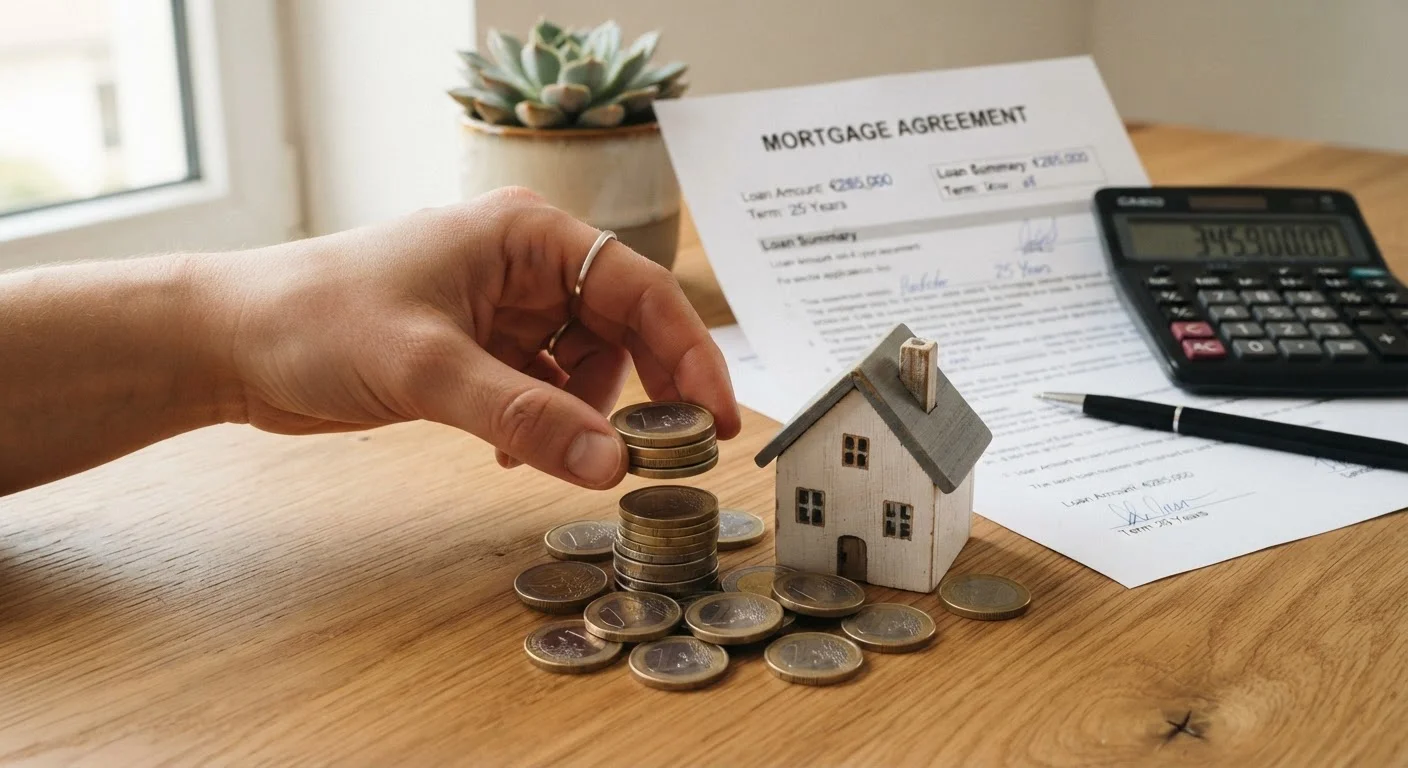
Why Your Down Payment Percentage Changes Everything
When you buy a home, the percentage you put down doesn't just reduce what you owe — it reshapes the entire structure of your loan. Lenders use your loan-to-value ratio (LTV) — the loan amount divided by the home's purchase price — to assess risk. A higher down payment means a lower LTV, which typically earns you better interest rates, eliminates certain fees, and reduces your monthly payment.
For a plain-language refresher on terms like LTV and APR, see our guide to common financial terms.
Understanding what each threshold actually means in dollar terms helps you make a deliberate choice rather than defaulting to folklore. The widely repeated "20% rule," for instance, isn't a requirement — it's a benchmark that carries specific financial advantages, but it's not the only workable path. Our article on home buying myths addresses this and other misconceptions in detail.
| 3%–5% Down | 10% Down | 20% Down | |
|---|---|---|---|
| PMI Required | Yes | Yes (reduced rate) | No |
| LTV at Purchase | 95%–97% | 90% | 80% |
| Typical Interest Rate Impact | Higher rate | Moderate rate | Lower rate |
| Upfront Capital Required | Lowest | Moderate | Highest |
| Post-Closing Cash Reserves | More preserved | Moderate | Least preserved |
| Equity at Closing | Minimal | Moderate | Strong |
| Suitable For | First-time buyers, limited savings | Mid-range savers | Well-capitalized buyers |
Breaking Down Each Down Payment Tier
3%–5%: The Low-Entry Option
Conventional loan programs backed by Fannie Mae and Freddie Mac allow qualified buyers to put down as little as 3%. FHA loans require a minimum of 3.5%. These options lower the barrier to homeownership but come with meaningful trade-offs: higher LTV means lenders consider you a greater risk, which translates to a higher interest rate and the addition of private mortgage insurance (PMI) — a monthly fee that protects the lender, not you, if you default.
PMI typically runs between 0.5% and 1.5% of the loan amount annually, depending on your credit score and lender. On a $350,000 loan, that's roughly $145–$438 per month added to your payment until your LTV reaches 80%.
Ask About Down Payment Assistance Programs
Many state and local housing agencies offer grants or forgivable loans to help qualifying buyers cover their down payment. Eligibility requirements vary by location and income level, but these programs can meaningfully reduce the upfront cash burden for first-time buyers. Contact your state's housing finance agency or a HUD-approved housing counselor to explore what's available in your area.
10%: The Middle Ground
A 10% down payment reduces your loan balance meaningfully, narrows your LTV, and often qualifies you for a modestly lower interest rate compared to 3%–5% tiers. PMI still applies, but at a reduced rate because your LTV is lower. This tier suits buyers who have savings but aren't in a position — or don't choose — to tie up 20% of a home's value in a single transaction.
20%: The Traditional Benchmark
At 20% down, your LTV hits 80%, the threshold at which conventional lenders no longer require PMI. You'll also generally qualify for better interest rates. On a $400,000 home, eliminating PMI alone can save several thousand dollars per year. The trade-off is the substantial upfront capital required — $80,000 in this example — which isn't achievable for every buyer without years of deliberate saving.
The Hidden Cost of Waiting Versus Acting
Some buyers delay purchasing in order to accumulate a larger down payment. This strategy can make sense in stable or declining markets, but in appreciating markets, home prices may rise faster than savings accumulate — meaning the target purchase price keeps moving upward. This isn't a guarantee either way, and local market conditions vary enormously.
Equally important: depleting savings to reach a higher down payment tier can leave you financially exposed. Homeownership carries ongoing costs — repairs, property taxes, insurance — and having little liquidity after closing can strain your budget if unexpected expenses arise. Before committing to a down payment amount, evaluate how much cash you'd retain for an emergency fund and routine maintenance.
If you're also weighing whether to buy at all, our comparison of renting vs. buying walks through the full financial and lifestyle considerations.
6%
Median down payment for first-time buyers
According to the National Association of Realtors, first-time buyers have historically put down around 6%, well below the 20% benchmark.
0.5%–1.5%
Typical annual PMI cost range
PMI is calculated as a percentage of the outstanding loan balance, varying based on creditworthiness and lender policies.
Loan Type, PMI, and Interest Rate Interactions
Your down payment doesn't operate in isolation — it interacts directly with the type of mortgage you choose. Fixed-rate and adjustable-rate mortgages each respond differently to LTV levels, and FHA loans carry their own mortgage insurance premium (MIP) structure that differs from conventional PMI.
With FHA loans, mortgage insurance is required regardless of down payment size if your term is 30 years and your down payment is under 10%. This makes a 10%+ down payment on an FHA loan strategically significant — it limits MIP to 11 years rather than the loan's full life.
VA loans (available to eligible veterans and service members) and USDA loans (for qualifying rural properties) may require no down payment at all, though other eligibility criteria apply. These programs can substantially change the calculus for qualifying borrowers.
This article is for general informational purposes only and does not constitute personalized financial or mortgage advice. Consult a licensed mortgage professional or financial adviser to evaluate options based on your specific circumstances.
Don't Confuse Down Payment With Closing Costs
Closing costs — which typically range from 2% to 5% of the purchase price — are separate from your down payment and must also be paid at settlement. Many buyers are caught off guard by this additional expense. Make sure your budget accounts for both when calculating how much you need to have on hand before closing.